
Cylloceria caligata
(Gravenhorst, 1829)
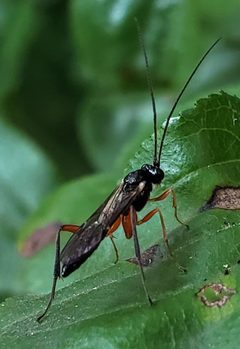
Cylloceria caligata is an ichneumonid in the Cylloceriinae, distinguished from by red and a relatively short ovipositor in females. The is trans-Palaearctic in distribution and one of three Cylloceria species recorded from Britain. It is a koinobiont endoparasitoid of cranefly larvae. The has been sequenced to level, representing the first such assembly for the subfamily Cylloceriinae.
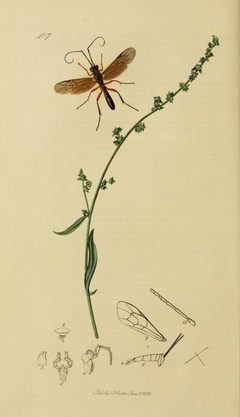
Pronunciation
How to pronounce Cylloceria caligata: //sɪloʊˈsɪəriə ˌkælɪˈɡeɪtə//
These audio files are automatically generated. While they are not always 100% accurate, they are a good starting point.
Identification
have a forewing length of approximately 6–8 mm. Females possess a relatively short ovipositor compared to other Cylloceria . Males exhibit characteristic semi-circular emarginations on flagellar segments 3 and 4. Red distinguish this species from other British Cylloceria.
Images
Habitat
Damp including stream banks and damp woodland areas; fly over low vegetation.
Distribution
Trans-Palaearctic; recorded from Britain (including Shropshire), Belgium, and Canada (Alberta).
Seasonality
On the wing from mid-summer through late autumn.
Host Associations
- Tipula - larvae; record inferred from related
- unidentified Tipulidae - cocoon; based on related C. aino
Life Cycle
Koinobiont endoparasitoid; endophagous in Diptera. Larvae develop within cranefly .
Behavior
fly over low vegetation in damp . Females use the ovipositor to contact and oviposit in concealed cranefly larvae.
Ecological Role
Koinobiont endoparasitoid of cranefly larvae (Tipulidae), contributing to of these dipterans in damp terrestrial .
Human Relevance
Subject of the first -level sequencing for Cylloceriinae (596.20 Mb genome assembled into 9 chromosomal pseudomolecules).
Similar Taxa
- Other Cylloceria speciesDistinguished by red and relatively short female ovipositor; other British lack red coxae.