
Lasioglossum oblongum
(Lovell, 1905)
Oblong Sweat Bee
Lasioglossum oblongum is a of sweat bee in the Halictidae. It belongs to the largest of bees, Lasioglossum, which contains over 1,700 species. As a member of the subgenus Dialictus, it is one of many small, often metallic bees that are frequently encountered in surveys and monitoring efforts. The species is documented from North America, with confirmed records from Vermont.

Pronunciation
How to pronounce Lasioglossum oblongum: /ˌlæsi.oʊˈɡlɒsəm ˈɒblɒŋɡəm/
These audio files are automatically generated. While they are not always 100% accurate, they are a good starting point.
Identification
Lasioglossum oblongum is a small sweat bee in the subgenus Dialictus. Members of this subgenus are typically minute to small in size, often with metallic coloration, and are among the most challenging bees to identify to level. Distinguishing L. oblongum from other Lasioglossum species requires examination of subtle morphological characters, including details of facial structure, punctation patterns on the mesoscutum, and male genitalia. The species epithet 'oblongum' likely refers to an oblong or elongated body shape characteristic of this species.
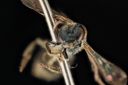
Images
Habitat
As a ground-nesting solitary , L. oblongum likely inhabits open, sunny areas with suitable soil for burrow excavation. Based on the of related Dialictus , it probably occurs in grasslands, meadows, and other open with low vegetation and exposed soil surfaces.
Distribution
North America. Documented from Vermont, United States. The broader range within North America is not well-documented in available sources.
Diet
As with other Lasioglossum , likely feed on nectar and pollen from a variety of flowering plants. Specific floral associations for this species are not documented in available sources.
Life Cycle
As a solitary , females likely nest independently in soil burrows, provisioning individual with pollen and nectar for their offspring. Males typically emerge before females. The may exhibit partial sociality or communal nesting common in some Lasioglossum species, but this has not been specifically documented for L. oblongum.
Ecological Role
As a , L. oblongum likely contributes to the pollination of wild flowering plants in its . Like other small halictid bees, it may be an important component of local pollinator , though its specific ecological contributions are not well-documented.
Similar Taxa
- Other Lasioglossum (Dialictus) speciesThe subgenus Dialictus contains numerous small, often metallic that are morphologically similar and difficult to distinguish without detailed examination. L. oblongum shares the general body plan and size range typical of this subgenus.
- Other HalictidaeSmall size and potential metallic coloration may cause confusion with other sweat bee such as Halictus or Agapostemon, though these typically have more distinct color patterns or larger body size.
Sources and further reading
- BugGuide
- Wikipedia
- GBIF taxonomy match
- iNaturalist taxon
- NCBI Taxonomy
- Catalogue of Life
- Just inTime for Pollinator Week | Bug Squad
- Bug Eric: Don't Sweat 'em
- Back-Seat Driver: The Parasite That Makes Bees Drop Off Its Babies
- Building a Better Bee Trap: Researchers Say Bee Bowls Are Overused
- Bug Eric: White Prairie Clover: An Awesome Blossom
- Not-so Solitary Bees - Buglife Blog - Buglife