
Lasioglossum laevissimum
(Smith, 1853)
Very Smooth Sweat Bee
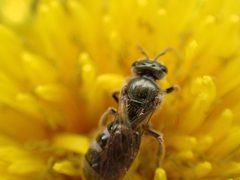
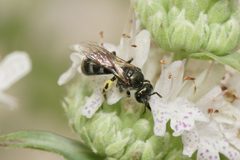
Lasioglossum laevissimum is a small metallic sweat bee in the subgenus Dialictus, one of the most -rich and taxonomically challenging groups of North American bees. The species was described by Smith in 1853 and has accumulated seven synonymies due to historical difficulties in distinguishing Dialictus species. It occurs in Canada and the northern United States, where it nests in soil and visits flowers for pollen and nectar. Like other Dialictus, it is likely a solitary or weakly social ground-nesting with females provisioning individual .
Pronunciation
How to pronounce Lasioglossum laevissimum: //ˌlæsioʊˈɡlɒsəm læˈvɪsɪməm//
These audio files are automatically generated. While they are not always 100% accurate, they are a good starting point.
Identification
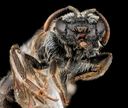
A small metallic sweat bee distinguished from similar Dialictus by specific morphological characters detailed in the Canadian revision. Males and females can be identified using the keys provided in Gibbs (2010), which resolved previous taxonomic confusion that led to multiple synonymies. The species name 'laevissimum' (very smooth) refers to integumental texture. Accurate identification requires examination of microscopic features; field identification to species is unreliable without specimen collection.
Images
Habitat
Ground-nesting found in open . Inferred from subgenus Dialictus characteristics and Canadian distribution to occupy areas with suitable soil for burrow excavation, likely including grasslands, meadows, and open woodland edges.
Distribution
North America: Canada and northern United States. Documented from Vermont, USA, and included in the Canadian revision of metallic Dialictus, indicating presence across at least eastern and central Canada.
Diet
visit flowers for nectar and pollen. Females collect pollen to provision for larval development. Specific floral associations not documented in available sources; likely a forager given the ecological pattern of Dialictus .
Life Cycle
Ground-nesting lifecycle typical of Halictidae: females excavate burrows in soil, construct individual , provision each with pollen and nectar, and lay a single per cell. Larvae develop within sealed cells, pupate, and emerge as . Degree of sociality not documented for this ; most Dialictus are solitary or weakly social with occasional production of small .
Ecological Role
of wild flowers. As a member of the diverse Dialictus subgenus, contributes to local diversity and functioning through pollination services.
Human Relevance
Attracted to human perspiration for salts and minerals, as characteristic of Halictidae. Sting is mild but can occur if is trapped against skin. Occasionally captured in bee bowl traps used for monitoring, though bowl traps poorly this and other small halictid relative to their actual abundance.
Similar Taxa
- Other Lasioglossum (Dialictus) speciesDialictus contains over 1,700 globally and 84 metallic species in Canada alone, most requiring microscopic examination for reliable identification. L. laevissimum was historically confused with multiple species now synonymized under it.
Sources and further reading
- BugGuide
- GBIF taxonomy match
- iNaturalist taxon
- NCBI Taxonomy
- Catalogue of Life
- Just inTime for Pollinator Week | Bug Squad
- Bug Eric: Don't Sweat 'em
- Back-Seat Driver: The Parasite That Makes Bees Drop Off Its Babies
- Building a Better Bee Trap: Researchers Say Bee Bowls Are Overused
- Bug Eric: White Prairie Clover: An Awesome Blossom
- Not-so Solitary Bees - Buglife Blog - Buglife
- Revision of the metallic species of Lasioglossum (Dialictus) in Canada (Hymenoptera, Halictidae, Halictini)