
Agapostemon melliventris
Cresson, 1874
Honey-tailed Striped Sweat Bee, honey-tailed striped-sweat bee
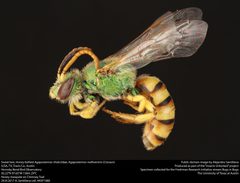
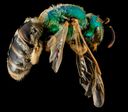
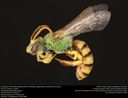
Agapostemon melliventris is a sweat bee in the Halictidae, commonly known as the honey-tailed striped sweat bee. Recent taxonomic revision has clarified its status as distinct from A. fasciatus, a species previously considered synonymous. The species appears to be of Sonoran origin, with most records from the south-western United States and northern Mexico. It belongs to a characterized by metallic green coloration in females, though specific traits distinguishing A. melliventris from include amber-colored metasomal segments in females and pale coloration on specific body parts in males.
Pronunciation
How to pronounce Agapostemon melliventris: /ˌæɡəˈpɒstɛmən ˌmɛlɪˈvɛntrɪs/
These audio files are automatically generated. While they are not always 100% accurate, they are a good starting point.
Identification
Distinguished from the closely related A. fasciatus by morphological characters of coloration and pattern, particularly in the metasomal segments and leg coloration. A. melliventris is generally found further south than A. fasciatus, which ranges into southern Canada. Accurate identification requires examination of specific diagnostic features rather than geographic inference alone, as the in the southern United States requires additional taxonomic work.
Images
Appearance
Females typically have at least the first three metasomal segments amber-colored, with pale maculations on the scape and apically. Males have the basal area of 1 pale amber to yellow and non-metallic (yellow or slightly greenish) . The exhibits typical of the , with females generally showing metallic green coloration on the and .
Distribution
South-western United States and northern Mexico; of apparent Sonoran origin. Most records are concentrated in this region, with the generally occurring south of the range of A. fasciatus.
Similar Taxa
- Agapostemon fasciatusPreviously considered a synonym or variety of A. melliventris, but now recognized as a distinct based on morphological and genetic evidence. A. fasciatus ranges further north into southern Canada, while A. melliventris is primarily southern in distribution.
- Agapostemon texanusAnother congeneric in the same with metallic green females; requires careful morphological examination to distinguish.
More Details
Taxonomic History
A. melliventris has undergone significant taxonomic revision. A. fasciatus was considered a variety of A. melliventris from the 1930s and placed into synonymy in the early 1970s. Recent morphological and barcode evidence has resurrected A. fasciatus as a valid , clarifying the status of A. melliventris as a distinct .
Ongoing Research Needs
Genetic data suggest that multiple may be present within the A. melliventris in the southern United States, indicating that additional taxonomic work is required to fully resolve boundaries in this region.
Sources and further reading
- BugGuide
- Wikipedia
- GBIF taxonomy match
- iNaturalist taxon
- Catalogue of Life
- California Has No State Bee--Yet! | Bug Squad
- The Native Bees in the UC Davis Bee Haven | Bug Squad
- Going Native: Do You Know the Native Bees of California? | Bug Squad
- Attracting Pollinators to Your Garden | Bug Squad
- 'Am I Even a Bee?' Identity Crisis Unfolds in This Charming Book | Bug Squad
- UC Davis Bee Garden Open House on May 12 | Bug Squad
- Agapostemon fasciatus Crawford (Hymenoptera, Halictidae), a valid North American bee species ranging into southern Canada