
Cyphomyrmex rimosus
(Spinola, 1851)
Rimose Fungus-farming Ant
Cyphomyrmex rimosus is a fungus-growing in the tribe Attini, native to the Neotropics. It is a small, slow-moving that cultivates fungal gardens for food. Colonies are typically small, with fewer than 500 . Workers are known to feign death when disturbed, remaining immobile for extended periods.
Pronunciation
How to pronounce Cyphomyrmex rimosus: /ˌsaɪfoʊˈmɪrmɛks ˈraɪmoʊsəs/
These audio files are automatically generated. While they are not always 100% accurate, they are a good starting point.
Identification
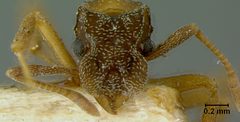
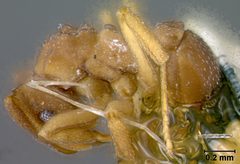
Distinguished from other Cyphomyrmex by the combination of: dull, mostly unsculptured body; appressed, -like pilosity; broad frontal lobes concealing antennal sockets; and absence of on the first gastral . The rimosus group is morphologically cohesive within the .
Images
Habitat
Found in soil, rotting wood on the ground, and leaf litter. Also occupies dead decaying tree limbs, moss mats on tree trunks, and epiphytic pseudobulbs.
Distribution
Native to the Neotropics. Recorded from Colombia (including Valle del Cauca, Leticia, Montería, and Villavicencio), the Galápagos Islands, and other parts of South and Central America. Introduced may occur in some regions.
Diet
Obligate fungus-grower; cultivates fungal gardens on which the colony feeds. The specific fungal cultivar is not documented for this .
Life Cycle
Colonies are small, probably not exceeding 500 and usually far fewer. Numerous dealate females are often present within colonies but appear to be non-reproductive; the reproductive structure of colonies is not fully understood.
Behavior
are slow-moving and become immobile when disturbed, sometimes for several minutes. When feigning death, appendages are drawn close to the body, making the resemble a small particle of soil or debris.
Ecological Role
Contributes to nutrient cycling through fungal and decomposition of organic matter in forest .
Human Relevance
Not a significant pest . May be encountered in agricultural or forested settings in its native range. Has been introduced to some areas outside its native range, including the Galápagos Islands.
Similar Taxa
- Cyphomyrmex longiscapusBoth are fungus-growing ants in the same , but C. longiscapus has longer scapes and has been documented to flee from raiding ants rather than feign death.
- Other Cyphomyrmex speciesC. rimosus belongs to the morphologically cohesive rimosus group, distinguished by the absence of on the first gastral and specific pilosity characteristics.
More Details
Subspecies
Two are recognized: Cyphomyrmex rimosus rimosus and Cyphomyrmex rimosus salvini.
Taxonomic History
Originally described as Cryptocerus rimosus by Spinola in 1851, later transferred to Cyphomyrmex.
Sources and further reading
- BugGuide
- Wikipedia
- GBIF taxonomy match
- iNaturalist taxon
- NCBI Taxonomy
- Catalogue of Life
- Cyphomyrmex longiscapus Archives - Entomology Today
- How Ants Do Battle: Toxic Sprays, Thick Armor, Overwhelming Numbers, and More
- Revisionary notes on the Fungus-growing Ants of the genus Cyphomyrmex, rimosus group (Hymenoptera: Formicidae: Attini)