
Colobopsis mississippiensis
(Smith, 1923)
Mississippi Gate-keeper Ant
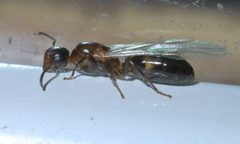
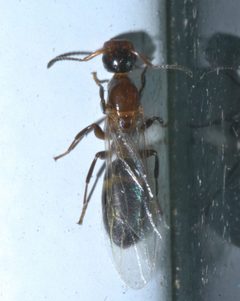
Colobopsis mississippiensis is a of in the Colobopsis, first described by Smith in 1923. It belongs to a group of ants commonly known as "gate-keeper ants" or "doorkeeper ants," characterized by specialized major with enlarged, plug-shaped used to block nest entrances. The species is native to North America, with records from the Mississippi region implied by its specific epithet. Like other members of the Colobopsis cylindrica group, it exhibits with distinct worker morphologies adapted for different colony functions.
Pronunciation
How to pronounce Colobopsis mississippiensis: /ˌkɒl.əˈbɒp.sɪs ˌmɪ.sɪˌsɪ.piˈɛn.sɪs/
These audio files are automatically generated. While they are not always 100% accurate, they are a good starting point.
Identification
Major possess characteristically enlarged, plug-shaped adapted for physically barricading nest entrances against intruders. Minor workers are smaller and lack the exaggerated head of majors. The can be distinguished from similar Colobopsis species by geographic distribution and subtle morphological differences in head shape and body proportions, though precise diagnostic features require examination.
Images
Distribution
Known from the United States, specifically associated with the Mississippi region based on the specific epithet. Records from iNaturalist indicate observations primarily from the southeastern United States.
Behavior
Major function as living doorkeepers, using their enlarged to plug nest entrances. This represents a defensive strategy against intruders and environmental threats. The degree to which minor workers exhibit defensive behaviors such as autothysis (self-sacrifice) in this is not documented.
Similar Taxa
- Colobopsis explodensBoth belong to the Colobopsis cylindrica group and share the gate-keeper with enlarged-headed major . C. explodens is distinguished by confirmed autothysis in minor workers and is native to Southeast Asia (Brunei), whereas C. mississippiensis is North American.
- Other Colobopsis cylindrica group speciesMultiple undescribed or poorly documented in this group share the general gate-keeper . Geographic separation and subtle morphometric differences typically separate these .