
Stigmina
Sacc., 1880
Genus Guides
1Stigmina is a of fungal plant in the Mycosphaerellaceae, established by Saccardo in 1880. in this genus cause leaf spot on a wide range of woody , including conifers and broadleaf trees. The genus is characterized by superficial sporodochia that develop through stomata, with arising laterally from the lower outer . Transmission occurs primarily via airborne conidia.
Pronunciation
How to pronounce Stigmina: //stɪɡˈmiː.nə//
These audio files are automatically generated. While they are not always 100% accurate, they are a good starting point.
Identification
Stigmina are distinguished from similar fungal by their superficial, flattened sporodochia that develop exclusively through stomata. arise only laterally from the lower, outer of the sporodochium, are macronematous, mononematous, brown, smooth, unbranched, and 1–2 septate. Conidiogenous cells are brown, monoblastic, integrated, terminal, percurrent with 3–4 annelations. Conidia are pale brown, cylindrical to , often curved, thick-walled, verrucose, and 5–8 distoseptate. These features separate Stigmina from Rhizosphaera species, which produce pycnidia rather than sporodochia.
Images
Habitat
occur on living leaves of plants in temperate and tropical regions. Stigmina lautii has been observed on symptomatic needles and adjacent green needles of spruce trees in western North Carolina, suggesting establishment in both diseased and apparently healthy tissue.
Distribution
The has been documented across six continents. Stigmina carpophila occurs throughout Africa, Asia, Australasia, Europe, North America, Central America, and South America. Stigmina lautii has been reported in Canada (Manitoba, Saskatchewan, British Columbia) and the United States (North Carolina). Stigmina deflectens occurs in Austria, Finland, Romania, Ukraine, Canada (Manitoba), and the United States (South Dakota). Stigmina mangiferae has been recorded from tropical and subtropical regions including Australia, Pacific islands, Africa, Asia, and the Caribbean.
Host Associations
- Prunus persica - causes shot-hole
- Prunus dulcis - almond
- Prunus armeniaca - apricot
- Prunus avium - sweet cherry
- Prunus cerasus - sour cherry
- Prunus domestica - plum
- Prunus laurocerasus - cherry laurel
- Picea pungens - blue spruce; first US record for Stigmina lautii
- Picea abies - Norway spruce; new record for Stigmina lautii
- Picea mariana - black spruce
- Picea glauca - white spruce
- Juniperus communis - common juniper
- Mangifera indica - mango
- Acer macrophyllum - broadleaf maple; of Stigmina zilleri
- Cocos nucifera - coconut; of Stigmina dura
- Platanus occidentalis - American sycamore
- Platanus orientalis - oriental plane
- Phoenix dactylifera - date palm and related Phoenix
- Anacardium occidentale - cashew; of Stigmina anacardii
Ecological Role
Stigmina function as foliar of woody plants. The association of Stigmina lautii with typical needle blight and its presence on both symptomatic and adjacent green needles suggests potential to spruce, though experimental confirmation is lacking for some species.
Human Relevance
cause economically significant leaf spot and shot-hole of stone fruits (peach, cherry, plum, apricot, almond) and other crops. Stigmina carpophila is a notable of Prunus species worldwide. Stigmina lautii represents an emerging pathogen of ornamental spruce in North America, with first US detection in 1999. The superficial similarity of Stigmina lautii sporodochia to pycnidia of Rhizosphaera kalkhoffii complicates field of spruce needle diseases.
Similar Taxa
- RhizosphaeraRhizosphaera kalkhoffii produces pycnidia that arise through stomata and cause similar needle blight on Picea; distinguished by pycnidial structure versus sporodochial structure of Stigmina
More Details
Taxonomic note
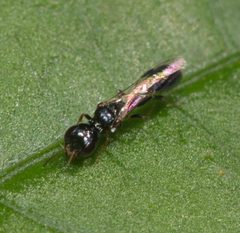
The name Stigmina has been used for both a fungal (Mycosphaerellaceae) and a subtribe of (Hymenoptera: Crabronidae). This record addresses the fungal genus.
Morphological variation
Conidial dimensions vary among : Stigmina lautii conidia measure 25–45 × 5–6 μm, while dimensions for other species may differ.
Transmission
Multiple are transmitted by airborne conidia, including S. carpophila, S. mangiferae, S. palmivora, S. millettiae, S. anacardii, S. tinea, S. platani, and S. dura.
Sources and further reading
- BugGuide
- Wikipedia
- GBIF taxonomy match
- iNaturalist taxon
- NCBI Taxonomy
- Catalogue of Life
- Stigmina carpophila . [Distribution map].
- Stigmina deflectens . [Distribution map].
- Stigmina glomerulosa . [Descriptions of Fungi and Bacteria].
- Stigmina dehradunensis, a new species associated with leaf spots in Ougeinia oojeinensis from India
- Stigmina palmivora . [Descriptions of Fungi and Bacteria].
- Stigmina anacardii . [Descriptions of Fungi and Bacteria].
- Stigmina tinea . [Descriptions of Fungi and Bacteria].
- Stigmina millettiae . [Descriptions of Fungi and Bacteria].
- Stigmina dura . [Descriptions of Fungi and Bacteria].
- Stigmina platani . [Descriptions of Fungi and Bacteria].
- Stigmina zilleri sp.nov., associated with brown leaf spot of broadleaf maple
- First Report of Stigmina lautii in the United States
- Stigmina mangiferae . [Descriptions of Fungi and Bacteria].
- Stigmina deflectens . [Descriptions of Fungi and Bacteria].
- Stigmina carpophila . [Descriptions of Fungi and Bacteria].