
Psilochalcis
Kieffer, 1905
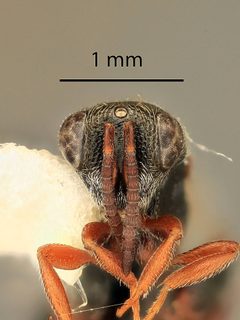
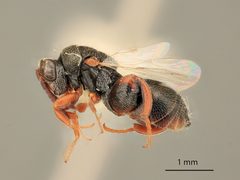
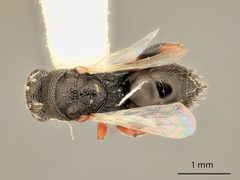
Psilochalcis is a of chalcidid wasps in the Chalcididae, established by Kieffer in 1905. The genus contains at least 20 described , with additional undescribed species known from North America. Two species, P. minuta and P. quadratis, have been studied in detail in the Eastern Great Basin of Utah, where they exhibit -specific associations with pinyon/juniper and cheatgrass-dominated vegetation respectively. Members of this genus are , with at least one species documented to oviposit in the pupal stage of insects.
Pronunciation
How to pronounce Psilochalcis: /ˌsaɪloʊˈkælsɪs/
These audio files are automatically generated. While they are not always 100% accurate, they are a good starting point.
Identification
Psilochalcis can be distinguished from other chalcidid by their placement in the tribe Hybothoracini within Haltichellinae. Species-level identification requires examination of morphological characters; P. minuta and P. quadratis were distinguished based on subtle morphological differences and associations in the Eastern Great Basin of Utah.
Images
Habitat
occur in diverse including pinyon/juniper woodlands, sagebrush steppe, cheatgrass-dominated areas, and crested wheatgrass stands in rangeland . One undescribed species from southern California inhabits the Algodones sand dune system, where it survives extreme daytime temperatures exceeding 110°F and sand surface temperatures above 160°F.
Distribution
Documented from western North America including Utah's Eastern Great Basin, southern California (Algodones Dunes), and potentially other arid and semi-arid regions. GBIF records indicate presence in California, Norway, and Sweden, though North American distribution is best documented. Two (P. minuta and P. quadratis) are known from limited occurrence data points in central Utah.
Seasonality
activity peaks from mid-May to early August in the Eastern Great Basin of Utah, based on two years of sampling. Seasonal abundance patterns differ between and types at the same geographic locations.
Host Associations
- small moth (undetermined species) - Females of an undescribed Psilochalcis from the Algodones Dunes lay in the pupal stage of , probably small feeding on desert bushes.
Life Cycle
Females oviposit in the pupal stage of insects. Further details of development are unknown.
Ecological Role
that contribute to regulation of in arid and semi-arid . P. minuta shows significant association with pinyon/juniper , while P. quadratis is significantly associated with cheatgrass habitat, suggesting partitioning between congeneric .
Human Relevance
from this have been featured in museum biolegacy programs offering species naming rights to donors, including an undescribed species collected from the Algodones Dunes by Bohart Museum of Entomology researchers.
Similar Taxa
- Other Chalcididae generaPsilochalcis belongs to tribe Hybothoracini, distinguishing it from chalcidids in other tribes; specific differentiating characters require detailed morphological examination.
More Details
Research history
The was established by Kieffer in 1905. Modern research has focused on distribution modeling and seasonal abundance of P. minuta and P. quadratis in Utah, revealing -specific associations and partially sympatric distributions. Maxent predictive models for these two species achieved AUC values of 0.70 and 0.68 respectively, with aspect, historic fire disturbance, and elevation contributing most to model predictions.
Sources and further reading
- BugGuide
- Wikipedia
- GBIF taxonomy match
- iNaturalist taxon
- NCBI Taxonomy
- Catalogue of Life
- Searching for the Most Unusual Gift? | Bug Squad
- The Perfect Gift | Bug Squad
- Seasonal Trap Abundance of Two Species of Psilochalcis Kieffer (Hymenoptera: Chalcididae) in Rangelands of the Eastern Great Basin of Utah, USA
- Maxent Predictive Species Distribution Models and Model Accuracy Assessment for Two Species of Psilochalcis Kieffer (Hymenoptera: Chalcididae) Occurring in the Eastern Great Basin of Utah, USA