
Cephini
Genus Guides
3Cephini is a tribe of stem sawflies within the Cephidae, characterized by cylindrical, elongated bodies and larvae that bore into the stems of grasses and sedges. Members of this tribe are distinguished from related groups by their reduced wing venation and the presence of a distinct, elongated ovipositor in females. The tribe includes economically significant pests such as the wheat stem sawfly.
Pronunciation
How to pronounce Cephini: /ˈkɛfɪnaɪ/
These audio files are automatically generated. While they are not always 100% accurate, they are a good starting point.
Identification
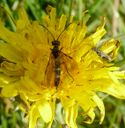
Cephini can be distinguished from the related tribe Janthini by the presence of a distinct postocellar furrow and the arrangement of antennal segments. Members exhibit a cylindrical, somewhat elongated body form with reduced wing venation compared to other . The forewings lack a closed anal , and the hindwings possess only one or two closed cells. Females possess an elongated, slender ovipositor adapted for inserting into plant stems.
Images
Habitat
Associated with grassland and agricultural where grasses and sedges occur. are often found in meadows, pastures, and cereal crop fields.
Distribution
Holarctic distribution, with recorded across North America, Europe, and northern Asia.
Diet
Larvae bore into and feed internally within stems of grasses (Poaceae) and sedges (Cyperaceae). Specific associations vary by ; some are restricted to particular grass .
Life Cycle
Complete with , larval, pupal, and stages. Females insert eggs into plant stems using the elongated ovipositor. Larvae develop within stems, typically descending to the base to overwinter. occurs within the stem or in soil.
Behavior
Females exhibit stem-boring oviposition , inserting directly into plant tissue. Larvae are endophytic, feeding internally and causing stem weakening or lodging in agricultural .
Ecological Role
Larvae act as stem borers in native grass , potentially influencing plant and providing food for . In agricultural settings, some function as significant pests of cereal crops.
Human Relevance
Includes Cephus cinctus (wheat stem sawfly), a major pest of wheat in North America causing economic losses through stem lodging and reduced grain yield. Management relies on wheat cultivars and agents.
Similar Taxa
- JanthiniJanthini is the other tribe in Cephidae; distinguished by the absence of a postocellar furrow and different antennal structure.