
Ceratina arizonensis
Cockerell, 1898
Arizona Small Carpenter, Arizona Ceratina
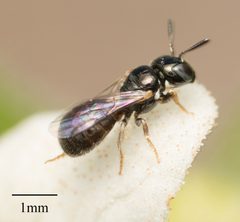
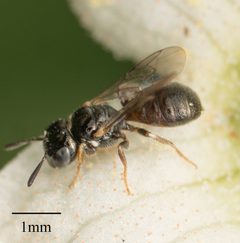
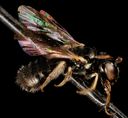
Ceratina arizonensis is a small carpenter bee in the Apidae, first described by Cockerell in 1898. It is one of numerous Ceratina native to North and Central America. Like other small carpenter bees, it is a solitary that nests in pithy stems rather than excavating wood like its larger relatives in Xylocopa. The species has been documented as a of multiple flowering plant species in field studies.
Pronunciation
How to pronounce Ceratina arizonensis: /ˌsɛrɑˈtiːnə ˌærɪzoʊˈnɛnsɪs/
These audio files are automatically generated. While they are not always 100% accurate, they are a good starting point.
Identification
Ceratina arizonensis can be distinguished from the eastern and southern U.S. Polistes exclamans (with which it was once confused taxonomically) by its geographic restriction to Arizona, southern California, and Mexico. Within the Ceratina, species-level identification typically requires examination of subtle morphological characters including facial markings, genitalia, and wing venation. The small carpenter bees as a group are recognized by their compact, somewhat metallic bodies and relatively sparse compared to other bees.
Images
Habitat
Found in arid and semi-arid environments of the southwestern United States and adjacent Mexico. Nests in pithy stems of various plants, a characteristic of the . Has been observed in restored prairie and urban environments in Arizona.
Distribution
North America: southwestern United States (Arizona, southern California); Mexico. Central America: presence recorded but specific countries not detailed in available sources.
Diet
feed on nectar; larvae provisioned with pollen and nectar. Specific plant records are limited in available sources.
Life Cycle
Solitary nesting typical of the : females excavate pithy plant stems to create linear series of , each provisioned with pollen and nectar before deposition. Developmental stages include egg, larva, pupa, and . No specific data available for this .
Behavior
Foraging has been observed to vary by flower : when visiting Penstemon digitalis or Monarda fistulosa, individuals tend to visit isolated flowers or show no preference for patch , but when visiting Eryngium yuccifolium, they prefer denser flower patches. This context-dependent foraging pattern distinguishes them from larger social bees like Bombus.
Ecological Role
Documented as a crop in global studies of wild contributions to agriculture. Part of the diverse wild bee that provides pollination services; however, like most Ceratina , it is not among the few species that provide the majority of crop pollination services. Contributes to plant in both natural and restored .
Human Relevance
Valued as a native in southwestern . Not known to be aggressive; lacks the wood-excavating habit of large carpenter bees, so does not damage structures. Presence in urban areas (e.g., Tucson) indicates of anthropogenic landscapes.
Similar Taxa
- Ceratina spp. (other small carpenter bees)Congeneric share similar size, nesting , and general appearance; require detailed morphological examination for separation.
- Xylocopa spp. (large carpenter bees)Larger relatives in the same Xylocopinae; distinguished by substantially greater body size and wood-excavating nesting .
More Details
Taxonomic History
Described by Theodore Dru Alison Cockerell in 1898, a prolific describer of North American bees.
Research Significance
Included in major global analyses of wild contributions to crop pollination, helping demonstrate that services are concentrated in a small subset of common while rare species contribute to biodiversity and ecosystem stability.
Sources and further reading
- BugGuide
- Wikipedia
- GBIF taxonomy match
- iNaturalist taxon
- NCBI Taxonomy
- Catalogue of Life
- Just inTime for Pollinator Week | Bug Squad
- Bug Eric: Wasp Wednesday: Polistes arizonensis
- Destination Sonoran Desert: A time to sting for the Giant Hairy Desert Scorpion, 'Hadrurus arizonensis' — Bug of the Week
- Bug Eric: A Spider Surprise
- Do Pollinators Prefer Dense Flower Patches? Sometimes Yes, Sometimes No
- BitB Best of 2009 | Beetles In The Bush