
Nomada vicina
Cresson, 1863
Neighborly Nomad
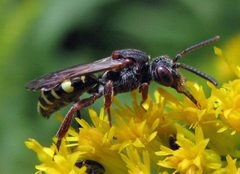
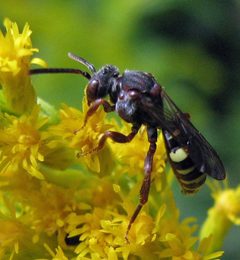
Nomada vicina is a of cuckoo bee in the Apidae, first described by Ezra Townsend Cresson in 1863. As a member of the Nomada, it exhibits kleptoparasitic , laying in the nests of species rather than constructing its own nests. The species is known from North America with confirmed records from Vermont and other regions. Like other Nomada species, it likely targets nests of mining bees in the genus Andrena. The "Neighborly Nomad" reflects both its parasitic lifestyle and its taxonomic proximity to related species.
Pronunciation
How to pronounce Nomada vicina: /nɔˈmaː.da vɪˈkiː.na/
These audio files are automatically generated. While they are not always 100% accurate, they are a good starting point.
Identification
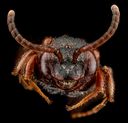
Nomada vicina can be distinguished from other Nomada by examining morphological features typical of the , including reduced scopae (pollen-collecting hairs) on females due to its cleptoparasitic lifestyle. Males and females exhibit the characteristic -like appearance of cuckoo bees, with relatively sparse body hair compared to non-parasitic bees. Precise identification to species level requires examination of genitalic structures and other detailed morphological characters, as many Nomada species are visually similar. The species lacks the dense branched hairs seen in pollen-collecting bees, instead possessing short, simple hairs.
Images
Distribution
North America; specifically recorded from Vermont, United States. The ' range within North America requires further documentation beyond the confirmed Vermont locality.
Host Associations
Ecological Role
As a kleptoparasitic , Nomada vicina functions as a nest of solitary bee , likely Andrena mining bees. This parasitic relationship represents a natural control mechanism within bee . The species contributes to biodiversity and serves as an indicator of healthy bee populations, as its presence implies functional nesting for its hosts.
Similar Taxa
- Nomada flavoguttataBoth are North American Nomada with similar cleptoparasitic and -like appearance; distinguished by specific morphological details and distribution
- Nomada goodenianaEuropean with similar kleptoparasitic and general ; N. vicina is distinguished by geographic range and subtle structural differences
- Nomada obtusifronsAnother Nomada with overlapping ; N. vicina differs in specific morphological characters and confirmed distribution
More Details
Taxonomic Status
The was validly described by Cresson in 1863 and remains accepted, though detailed modern taxonomic revision may be needed to clarify its precise boundaries and relationships within the large and taxonomically complex Nomada.
Data Deficiency
Despite being described over 160 years ago, Nomada vicina remains poorly documented in the literature, with limited information on its , associations, and full geographic range. This reflects a broader pattern of data deficiency for many North American Nomada .
Sources and further reading
- BugGuide
- GBIF taxonomy match
- iNaturalist taxon
- NCBI Taxonomy
- Catalogue of Life
- Image by UC Davis Alumnus Ian Wright Appears in ESA World Calendar | Bug Squad
- entomology | Blog - Part 10
- Northern Ireland, invertebrate finds in review 2023 - Buglife Blog - Buglife
- Not-so Solitary Bees - Buglife Blog - Buglife
- Advanced Mass Spectrometry Method Could Give Forensic Entomologists Faster Fly IDs
- Bare ground experiments to help save rare bees and wasps - Buglife Blog - Buglife