
Nomada luteoloides
Robertson, 1895
Black-and-yellow Nomad Bee
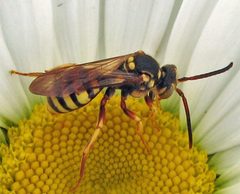
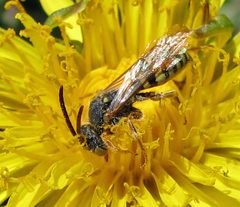
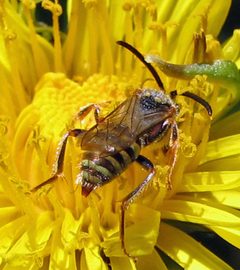
Nomada luteoloides is a of cuckoo bee in the Apidae, native to North America. As a kleptoparasite, it does not construct its own nest or collect pollen, instead laying in the nests of species. The female offspring develop by consuming the host's provisions and often the host egg or larva. The species is part of the diverse Nomada , which contains numerous cuckoo bee species that parasitize various ground-nesting bees, particularly in the genus Andrena.
Pronunciation
How to pronounce Nomada luteoloides: /nəˈmɑːdə ljuːtiˈoʊlɔɪdz/
These audio files are automatically generated. While they are not always 100% accurate, they are a good starting point.
Images
Distribution
Recorded from North America, with specific presence documented in Vermont, United States. GBIF distribution records indicate occurrence across North America.
Host Associations
Similar Taxa
- Nomada flavoguttataBoth are North American Nomada with similar kleptoparasitic ; N. flavoguttata has been studied for antennal grabbing during copulation
More Details
Genus-level behavioral context
While specific for N. luteoloides are not documented, research on congeneric N. flavoguttata has described 'antennal grabbing' during copulation—where males wind their around the female's to transfer . This behavior was first recorded for the Nomada in 2018 by Schindler et al.
Conservation notes
As with many solitary , N. luteoloides depends on bare ground for nesting sites. Conservation efforts targeting ground-nesting bees, such as creation of 'bee beaches' (patches of bare, warm, sandy soil), may indirectly benefit this cuckoo bee by supporting host .
Sources and further reading
- BugGuide
- Wikipedia
- GBIF taxonomy match
- iNaturalist taxon
- NCBI Taxonomy
- Catalogue of Life
- Image by UC Davis Alumnus Ian Wright Appears in ESA World Calendar | Bug Squad
- entomology | Blog - Part 10
- Northern Ireland, invertebrate finds in review 2023 - Buglife Blog - Buglife
- Not-so Solitary Bees - Buglife Blog - Buglife
- Bare ground experiments to help save rare bees and wasps - Buglife Blog - Buglife
- behaviour | Blog