
Nomada imbricata
Smith, 1854
Imbricate Cuckoo Nomad Bee
Nomada imbricata is a of cuckoo bee in the Apidae, first described by Smith in 1854. Like all Nomada species, it is a kleptoparasite that lays its in the nests of species, primarily members of the Andrena. The species exhibits the characteristic reduced hairiness of cuckoo bees, having lost the branched body hairs used by pollen-collecting bees. Its "Imbricate" refers to the overlapping -like pattern of its .
Pronunciation
How to pronounce Nomada imbricata: /nɔˈmaː.da ˌɪm.brɪˈkaː.ta/
These audio files are automatically generated. While they are not always 100% accurate, they are a good starting point.
Identification
Nomada imbricata can be distinguished from other Nomada by its imbricate pattern and specific coloration. As with all Nomada, it lacks the dense branched hairs characteristic of pollen-collecting bees, instead presenting a relatively smooth, -like appearance. Accurate identification to species level typically requires examination of morphological details including genitalia and specific pattern elements. The species may be confused with other Nomada species, particularly those with similar color patterns in the same geographic region.
Images
Appearance
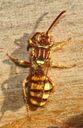
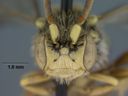
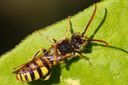
Nomada imbricata exhibits the typical -like appearance of cuckoo bees, with reduced body hair compared to pollen-collecting bees. The has short, sparse hairs that form distinct color patterns, typically incorporating black, white, red, and yellow. The shows an imbricate (overlapping -like) pattern that gives the species its . Body size falls within the range typical for Nomada species, approximately 5–10 mm in length. The mandibular glands of males produce chemical compounds.
Habitat
Nomada imbricata is associated with where its occur. As a kleptoparasite of ground-nesting Andrena bees, it requires areas with suitable bare ground or soil substrates for host nesting. The species has been documented in Vermont, suggesting occurrence in temperate North American habitats including open woodlands, meadows, and other areas supporting diverse bee .
Distribution
North America, with confirmed records from Vermont, United States. The ' range within North America is not fully documented but appears to be centered in the northeastern United States.
Seasonality
Activity patterns follow those of its , with typically active during the spring and summer months when Andrena hosts are nesting. Specific period data for N. imbricata is limited.
Host Associations
Life Cycle
Nomada imbricata exhibits the typical cleptoparasitic of the . Females locate nests of Andrena , often using olfactory cues including floral oil scents. They enter unguarded nests and lay in provisioned . The Nomada larva hatches before the host larva, kills the host egg or young larva, and consumes the pollen and nectar provision. Development proceeds with the parasitic larva using the host's stored resources. The species likely has a or cycle depending on host , with emerging to mate and seek host nests.
Behavior
Males have been observed to patrol areas where bees are active, including flowers such as willow and gooseberry. Male Nomada exhibit "antennal grabbing" during copulation, winding their around the female's antennae to transfer . This behavior, first documented in the Nomada in 2018, may serve to transfer chemical compounds that help females mimic host odors for nest entry, or may function to make females unattractive to rival males. Males also deposit pheromones on vegetation by rubbing their bodies against grass to mark mating territories.
Ecological Role
As a kleptoparasite, Nomada imbricata functions as a natural regulator of its . Cuckoo bees contribute to bee dynamics and may influence host nesting and distribution. The species participates in pollination networks indirectly through its association with host foraging activities, though it does not actively collect pollen.
Human Relevance
Similar Taxa
- Nomada flavoguttataShares similar color pattern elements and geographic range; both are North American Nomada with yellow markings. Distinguished by specific pattern details and texture.
- Other Nomada speciesMany Nomada exhibit similar -like appearance with black, yellow, red, and white patterns. Accurate identification requires detailed morphological examination, particularly of male genitalia and specific patterns.
- Andrena host speciesMay be confused with bees when observed quickly, but Andrena have dense branched body hairs for pollen collection, while Nomada imbricata has sparse, short, unbranched hairs giving a smoother appearance.
More Details
Nomenclature
The specific epithet "imbricata" refers to the overlapping, -like pattern of the , characteristic of this .
Taxonomic status
Nomada imbricata was described by Frederick Smith in 1854 and remains a valid, accepted . The Nomada is species-rich with over 850 described species globally, making species-level identification challenging.
Observation records
As of 2024, iNaturalist records approximately 335 observations for this , indicating it is documented but not commonly encountered.
Sources and further reading
- BugGuide
- GBIF taxonomy match
- iNaturalist taxon
- NCBI Taxonomy
- Catalogue of Life
- Image by UC Davis Alumnus Ian Wright Appears in ESA World Calendar | Bug Squad
- entomology | Blog - Part 10
- Northern Ireland, invertebrate finds in review 2023 - Buglife Blog - Buglife
- Not-so Solitary Bees - Buglife Blog - Buglife
- Bare ground experiments to help save rare bees and wasps - Buglife Blog - Buglife
- behaviour | Blog