
Nomada crotchii
Cresson, 1878
Crotch's Nomad
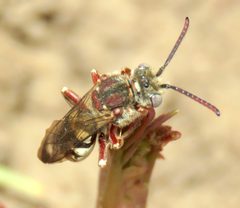
Nomada crotchii is a of nomad bee (kleptoparasitic cuckoo bee) in the Apidae. It occurs in North America. As a member of the Nomada, it is presumed to be a nest of other bees, though specific relationships have not been documented for this species. The species was described by Cresson in 1878 and has two recognized : N. c. crotchii and N. c. nigrior.
Pronunciation
How to pronounce Nomada crotchii: //nɔˈmɑːdə ˈkrɒtʃi.aɪ//
These audio files are automatically generated. While they are not always 100% accurate, they are a good starting point.
Images
Distribution
North America. Specific distribution records are sparse, but the has been documented in the western United States including California, where it has been recorded in the UC Davis Arboretum.
Host Associations
- Nomada crotchii - kleptoparasiteAs a member of the Nomada, this is presumed to parasitize nests of other bees, but specific species are not documented.
Ecological Role
Kleptoparasite (cuckoo bee). Nomada reduce reproductive success of their bees by laying in host nests; emerging larvae consume host provisions and typically kill the host egg or larva.
Similar Taxa
- Nomada zonataBoth are North American Nomada with similar kleptoparasitic , though N. zonata is a more recent colonist to Britain and is expanding its range in response to climate change.
- Nomada goodenianaBoth are yellow-and-black patterned nomad bees that parasitize Andrena mining bees, though N. goodeniana is primarily European.
- Nomada obtusifronsBoth are rare nomad bees with limited distribution records; N. obtusifrons is listed as Endangered on the Regional Red List of Irish Bees.
- Nomada striataBoth are kleptoparasitic nomad bees with coastal associations in parts of their range; N. striata is known from coastal in Northern Ireland.
More Details
Conservation status
Nomada crotchii has been described as rare. A 2022 record from the UC Davis Arboretum noted that observing this "would be amazing to see," suggesting it is not commonly encountered even within its known range.
Research context
The is included in the California Bumble Bee Atlas, a collaborative science effort to track and conserve native species in California, indicating ongoing interest in documenting its distribution and abundance.
Sources and further reading
- BugGuide
- Wikipedia
- GBIF taxonomy match
- iNaturalist taxon
- NCBI Taxonomy
- Catalogue of Life
- Saving California's Bumble Bees: Become a Citizen Scientist | Bug Squad
- Image by UC Davis Alumnus Ian Wright Appears in ESA World Calendar | Bug Squad
- entomology | Blog - Part 10
- Northern Ireland, invertebrate finds in review 2023 - Buglife Blog - Buglife
- Not-so Solitary Bees - Buglife Blog - Buglife
- Bare ground experiments to help save rare bees and wasps - Buglife Blog - Buglife