
Eucera frater
(Cresson, 1878)
Monk Longhorn
Species Guides
2- Eucera frater albopilosa(White-haired Monk Longhorn)
- Eucera frater lata
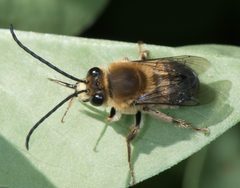
Eucera frater is a of long-horned bee in the Apidae, found in North America. It belongs to the tribe Eucerini, a group of solitary bees characterized by elongated in males. The species was originally described as Melissodes frater by Cresson in 1878 and later transferred to the Eucera. Three are recognized: E. f. albopilosa, E. f. frater, and E. f. lata.


Pronunciation
How to pronounce Eucera frater: /juːˈsɛ.rə ˈfreɪ.tər/
These audio files are automatically generated. While they are not always 100% accurate, they are a good starting point.
Identification
As a member of the long-horned bee tribe Eucerini, males likely possess conspicuously elongated relative to females, a diagnostic trait of the group. However, specific distinguishing features for E. frater compared to other Eucera are not documented in available sources. Females may be distinguished from males by their more robust build and shorter antennae.
Images
Distribution
North America. Specific range details beyond continental distribution are not documented.
Similar Taxa
- Eucera longicornisAnother long-horned bee in the same , but found in Europe rather than North America; males have extremely long and females may be confused with flower bees (Anthophora)
- Eucera pruinosaNorth American congeneric , noted as an efficient of cucurbits; distinguished by specific plant associations not documented for E. frater
More Details
Subspecies
Three are recognized: Eucera frater albopilosa (Fowler, 1899), Eucera frater frater (Cresson, 1878), and Eucera frater lata (Provancher, 1888). The nominate subspecies E. f. frater was originally described as Melissodes frater.
Sources and further reading
- BugGuide
- Wikipedia
- GBIF taxonomy match
- iNaturalist taxon
- NCBI Taxonomy
- Catalogue of Life
- Grasshoppers of Colorado
- Grasshoppers of Colorado
- Species Records and Accounts
- ESA Entomology Games Are Both Educational and Entertaining | Bug Squad
- Wild Pollinators Get the Job Done
- Conservation Volunteering at Prawle Point with Buglife - Buglife Blog - Buglife