
Bombus vandykei
(Frison, 1927)
Van Dyke's bumble bee, Van Dyke's bumblebee
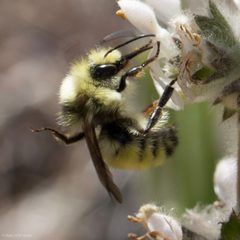
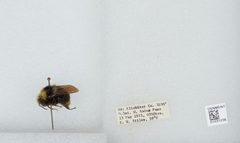
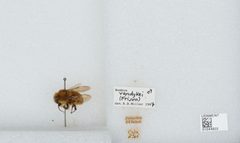
Bombus vandykei, commonly known as Van Dyke's , is a of bumble bee native to western North America. The species was first described by Frison in 1927 and is named in honor of entomologist Henry Van Dyke. It is a medium-sized bumble bee with distinctive coloration that distinguishes it from closely related species. The IUCN lists the species as Least Concern with a stable .
Pronunciation
How to pronounce Bombus vandykei: /ˈbɒm.bəs vænˈdaɪ.ki/
These audio files are automatically generated. While they are not always 100% accurate, they are a good starting point.
Identification
Bombus vandykei can be distinguished from the closely related Bombus flavifrons (yellow-fronted ) by its predominantly black with only the first segment yellow, whereas B. flavifrons has more extensive yellow on the abdomen. It differs from Bombus vosnesenskii (yellow-faced bumble bee) by the presence of the black band on the and the more limited yellow on the abdomen. The yellow distinguishes it from with black or partially black faces such as Bombus melanopygus.
Images
Habitat
Found in diverse across its range including coastal scrub, chaparral, oak woodlands, montane meadows, and urban gardens. The shows adaptability to both natural and disturbed habitats. It occurs from low elevations to montane zones, with specific elevational range varying by region.
Distribution
Western North America, ranging from British Columbia south through Washington, Oregon, and California. The eastern extent of its range reaches into Idaho and western Montana. The is most abundant in the Pacific coastal states and provinces.
Seasonality
Active from early spring through late fall, with peak activity during summer months. Queens emerge from hibernation in early spring to establish colonies. are present throughout the growing season. Males and new queens are produced in late summer and fall, with mating occurring before queens enter hibernation.
Diet
forager that collects nectar and pollen from a wide variety of flowering plants. Documented visiting lavender (Lavandula), Phacelia californica, and other native and ornamental flowers. As with all bumble bees, larvae are fed a mixture of pollen and nectar (), while consume nectar for energy and pollen for protein.
Life Cycle
eusocial colony cycle. Solitary queens emerge from hibernation in spring and found colonies. Queens lay that develop into . Colony grows through summer with worker production. In late summer, queens switch to producing males and new queens. Males leave the nest and do not return. New queens mate and enter hibernation to found colonies the following year. The original , males, and workers die with the onset of winter.
Behavior
Colonial nesting in underground cavities, often repurposing abandoned rodent burrows or other pre-existing cavities. forage during daylight hours, with activity patterns influenced by temperature and floral resource availability. Workers communicate resource location through unspecified means but do not perform the of honey bees. Defensive includes stinging when the nest is threatened; workers can sting multiple times unlike workers.
Ecological Role
Important of native wildflowers and agricultural crops. Contributes to plant through buzz pollination of certain plant . Serves as prey for various including beewolf (Philanthus spp.) and birds. Participates in nectar microbial dynamics as documented in research on sticky monkeyflower (Mimulus auranticus).
Human Relevance
Valued as a native in gardens and agricultural settings. Has been documented in urban garden environments such as Vacaville, California. Not commercially reared for pollination services. Subject of citizen science monitoring through platforms such as iNaturalist. No known negative impacts on human activities.
Similar Taxa
- Bombus flavifronsSimilar yellow thoracic coloration but differs in having more extensive yellow on abdominal segments T2-T3, whereas B. vandykei has T2-T6 black
- Bombus vosnesenskiiShares yellow but lacks the black thoracic band and has more extensive yellow on
- Bombus melanopygusOverlaps in range and but has black and different abdominal color pattern
More Details
Taxonomic History
Originally described as a Bremus flavifrons vandykei by Frison in 1927, later elevated to full status as Bombus vandykei. The specific epithet honors Henry Van Dyke, an entomologist who contributed to the study of North American bumble bees.
Research Documentation
Photographed by entomologist Gwen Erdosh and documented in scientific literature on -plant interactions. Has been observed sharing flowers with honey bees (Apis mellifera) on Phacelia californica in research settings.
Sources and further reading
- BugGuide
- Wikipedia
- GBIF taxonomy match
- iNaturalist taxon
- NCBI Taxonomy
- Catalogue of Life
- Celebrating Bumble Bees on World Bee Day | Bug Squad
- Surprising Research Results: What the Microbes in Nectar Revealed | Bug Squad
- What Native California Plants Are Best for Attracting Pollinators? | Bug Squad
- The Amazing World of 'Gwentomologist' Gwen Erdosh | Bug Squad
- Look Out, Franklin's Bumble Bee, They're Coming for You! | Bug Squad
- Bumble Bee Mellowing Out on the Mallow | Bug Squad