
Bombus sitkensis
Nylander, 1848
Sitka bumble bee, Sitka bumblebee
Bombus sitkensis, the Sitka , is a medium-sized bumble bee native to western North America. It is distinguished by its distinctive color pattern featuring yellow and black on the with a black central patch, yellow on the first two abdominal segments, black on segments three and four with yellow rims, and brownish-red terminal segments. The species exhibits an exceptionally long period for queens, spanning nearly the entire year in some . It has experienced mild population declines in parts of California due to competition with Bombus vosnesenskii for nesting sites.
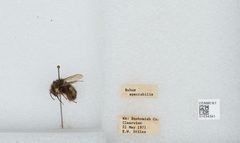
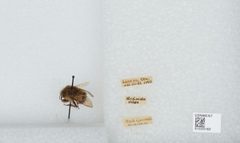
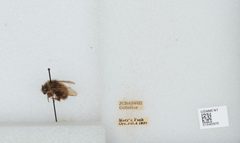
Pronunciation
How to pronounce Bombus sitkensis: /ˈbɒmbʊs sɪtˈkɛn.sɪs/
These audio files are automatically generated. While they are not always 100% accurate, they are a good starting point.
Identification
Distinguished from similar western bumble bees by the combination of: black central thoracic patch in females (absent in B. vosnesenskii); yellow 1–2 with black terga 3–4 bearing yellow rim; and brownish-red terminal abdominal segments. The long period of queens (January–December) is unusual among bumble bees and may aid identification in winter-active individuals. B. vosnesenskii lacks the black thoracic patch and has different abdominal patterning. B. melanopygus has black on terga 2 and different tail coloration.
Images
Appearance
Medium-sized with oblong and medium-length . Females (queens and ) have black and yellow hairs intermixed on and , with a distinct black patch centrally on thorax and yellowish sides. 1 and 2 yellow; terga 3 and 4 black with yellow rim on tergum 4; terga 5 and 6 brownish-red. Males have yellow face and anterior thorax, with darker posterior thorax (black and yellow intermixed). Male : terga 1 and 2 yellow; terga 3–5 yellow anteriorly, black posteriorly; terga 6–7 brownish-red.
Habitat
Found in diverse across its western North American range, from coastal areas to montane regions. Utilizes rodent burrows and other underground cavities for nesting. Forages in areas supporting flowering plants of Ericaceae, Asteraceae, Saxifragaceae, and Rhamnaceae.
Distribution
Western North America from Alaska and British Columbia south through Washington, northern Idaho, western Montana, and coastal California. Core range spans the Pacific coastal region and adjacent interior mountains.
Seasonality
Queens active from late January to early December—an exceptionally long period. First emerge in early March. Males appear in early April and persist until late September. Both worker and male absent from October through early January.
Diet
Nectar and pollen from flowering plants in Ericaceae, Asteraceae, Saxifragaceae, and Rhamnaceae. Specific plant not documented in available sources.
Life Cycle
colony cycle with solitary initiation. Queens establish colonies in spring (earliest recorded January), producing beginning March. Male production begins April. Colony decline occurs September–October with new queens entering . Exact timing varies geographically.
Behavior
Nests in pre-existing underground cavities, particularly rodent burrows. Engages in active foraging across extended seasonal window enabled by physiological of cool temperatures. In California, has been observed competing with Bombus vosnesenskii for limited nesting sites.
Ecological Role
of native flowering plants in western North American . Contributes to pollination services in Ericaceae, Asteraceae, Saxifragaceae, and Rhamnaceae. Serves as prey/ for parasitic bees and other insects (specific not documented).
Human Relevance
Subject of monitoring through California Bumble Bee Atlas and related citizen science initiatives. Mild declines in California parks have been documented, prompting conservation interest. Not a significant agricultural compared to some .
Similar Taxa
- Bombus vosnesenskiiOverlaps extensively in range and ; distinguished by lack of black thoracic patch, different abdominal color pattern, and generally more extensive yellow coloration
- Bombus melanopygusShares western North American distribution; differs in having black on 2 and different tail coloration
More Details
Conservation status
Has experienced mild declines in California state parks attributed to competition with Bombus vosnesenskii for nesting sites such as rodent holes. Not currently listed as threatened or endangered, but included in regional monitoring efforts.
Taxonomic note
Described by Nylander in 1848; name refers to Sitka, Alaska, within its northern range.
Sources and further reading
- BugGuide
- Wikipedia
- GBIF taxonomy match
- iNaturalist taxon
- NCBI Taxonomy
- Catalogue of Life
- Celebrating Bumble Bees on World Bee Day | Bug Squad
- Bumble Bee Mellowing Out on the Mallow | Bug Squad
- The Buzz: Protecting Our Bumble Bees | Bug Squad
- California Has No State Bee--Yet! | Bug Squad
- Saving California's Bumble Bees: Become a Citizen Scientist | Bug Squad
- Bumble Bees: Feeling Impact of Climate Change | Bug Squad