
Anthophora urbana
Cresson, 1879
Urbane Digger Bee
Anthophora urbana is a solitary ground-nesting in the Apidae, commonly known as the Urbane Digger Bee. It is native to Central America and North America, with a broad distribution that includes arid regions such as the Mojave and Sonoran deserts. The is a floral , collecting pollen and nectar from diverse plant species. A. urbana is notable for being proposed as a candidate for California's state bee due to its widespread presence and representation of solitary native bees.
Pronunciation
How to pronounce Anthophora urbana: /ænˈθɒfərə ˈɜːrbænə/
These audio files are automatically generated. While they are not always 100% accurate, they are a good starting point.
Identification
Distinguished from other Anthophora by the combination of black body with gray hair bands on the and moderate size (10–13 mm). The gray-banded abdominal pattern separates it from uniformly colored or differently patterned . As a solitary , it lacks the dense hair covering and larger size of bumble bees (Bombus), and differs from honey bees (Apis mellifera) in its solitary and lack of yellow coloration.
Images
Appearance
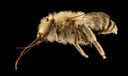
are black with gray hairs, including gray bands around the . Body length ranges from 10–13 mm. The exhibits the robust, hairy body typical of digger bees in the Anthophora.
Habitat
Occupies diverse environments including arid lands, desert regions, and urban green spaces. Documented in the Mojave and Sonoran deserts, where it utilizes undisturbed . Also observed in agricultural and ornamental landscapes, including lavender plantings and gardens.
Distribution
Native to North America and Central America. Documented across the western United States including California, with specific records from the Mojave Desert, Sonoma, and San Clemente Island (where A. urbana clementina occurs). Present in Mexico and Central American countries.
Diet
Floral ; collects pollen and nectar from multiple plant . Documented foraging on lavender (Lavandula), Ageratum houstonianum 'Blue Horizon', and other flowering plants in agricultural and ornamental settings.
Life Cycle
Ground-nesting solitary . Females excavate burrows in soil for nest construction. Development includes , larval, and pupal stages within individual nest provisioned with pollen and nectar. are active during warm seasons, with specific varying by region.
Behavior
Solitary forager; does not form colonies. Exhibits rapid, direct patterns between flowers. Has been observed in flight approaching flowers and actively collecting nectar. Males may patrol nesting areas.
Ecological Role
of wild and cultivated flowering plants. Contributes to services in arid land ecosystems and agricultural settings. As a forager, supports plant diversity and crop pollination.
Human Relevance
Proposed as a candidate for California state to represent native solitary bee diversity. Featured in conservation education and research on solar energy facility restoration. Photographed extensively for native bee awareness campaigns.
Similar Taxa
- Anthophora californicaOverlapping range in California; differs in hair coloration and banding pattern
- Xylocopa spp. (carpenter bees)Similar size and black coloration, but carpenter bees have shiny, largely hairless and nest in wood rather than soil
- Bombus vosnesenskiiAlso proposed as California state candidate; bumble bees are social, larger, and have yellow facial markings and denser hair
More Details
Conservation Significance
Highlighted in research on techno-ecological synergies for solar energy development as an example of native diversity requiring protection in renewable energy siting decisions.
Taxonomic Note
A. urbana clementina is restricted to San Clemente Island, indicating geographic variation within the .
Sources and further reading
- BugGuide
- Wikipedia
- GBIF taxonomy match
- iNaturalist taxon
- NCBI Taxonomy
- Catalogue of Life
- California Has No State Bee--Yet! | Bug Squad
- ESA to Meet in Portland, Ore. | Bug Squad
- Pollinator Habitat: Important Part of Solar Energy Study | Bug Squad
- Pollination Ecologist Neal Williams: The Importance of Native Bees | Bug Squad
- Bugs and Bees, Bees and Bugs | Bug Squad
- 'Am I Even a Bee?' Identity Crisis Unfolds in This Charming Book | Bug Squad