
Andrena sphaeralceae
Linsley, 1939
Globemallow Andrena
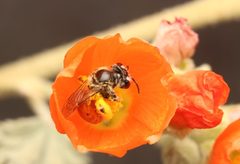
Andrena sphaeralceae, commonly known as the Globemallow Andrena, is a of mining bee in the Andrenidae. It is a solitary that excavates underground nests in soil. The species is found in North America and Central America. As a member of the large Andrena, it contributes to spring pollination of wildflowers. The specific epithet 'sphaeralceae' suggests a likely association with plants in the genus Sphaeralcea (globemallows), though this relationship requires confirmation.
Pronunciation
How to pronounce Andrena sphaeralceae: /ænˈdriːnə sfɪəˈrælsiːiː/
These audio files are automatically generated. While they are not always 100% accurate, they are a good starting point.
Images
Habitat
As a ground-nesting mining bee, requires bare or sparsely vegetated soil for nest excavation. Warm, dry, south-facing slopes with exposed soil are preferred nesting sites. Foraging includes areas with suitable pollen sources.
Distribution
Recorded from North America and Central America. Distribution records indicate presence in both regions, though specific range boundaries within these areas are not well documented.
Host Associations
- Sphaeralcea - probable pollen sourceSpecific epithet suggests association with globemallow , but this requires verification
Life Cycle
As a solitary mining bee (Andrenidae), females excavate individual underground tunnels with multiple . Each cell is provisioned with pollen and nectar, an is laid, and the cell is sealed. Larvae develop underground, pupate, and emerge as the following season. Males typically emerge before females.
Behavior
Nests solitarily in where suitable soil conditions exist. Females excavate tunnels and provision with pollen collections. Males patrol nesting areas seeking emerging females.
Ecological Role
Similar Taxa
- Other Andrena speciesLarge with many similar-sized mining bees; identification to level requires examination of morphological details including facial foveae, scopal hairs, and male genitalia
- Andrena tarsataAnother mining bee with plant-associated specific epithet; however, A. tarsata is associated with Potentilla (Tormentil) rather than Sphaeralcea
More Details
Nomenclature
The specific epithet 'sphaeralceae' (genitive of Sphaeralcea) was established by Linsley in 1939, indicating the was described with reference to globemallow plants. This follows a common pattern in Andrena where species are named for their presumed plants.
Sources and further reading
- BugGuide
- Wikipedia
- GBIF taxonomy match
- iNaturalist taxon
- NCBI Taxonomy
- Catalogue of Life
- Not-so Solitary Bees - Buglife Blog - Buglife
- Northern Ireland, invertebrate finds in review 2023 - Buglife Blog - Buglife
- In a New Study, Spring Forest Bees Get Their Due
- Bare ground experiments to help save rare bees and wasps - Buglife Blog - Buglife
- What’s in a name….? - Buglife Blog - Buglife
- Bees of the Changing Chalk Partnership Area - Buglife Blog - Buglife