
Andrena prunorum
Cockerell, 1896
Prunus Miner Bee, Purple Miner Bee
Andrena prunorum is a solitary mining bee in the subgenus Plastandrena, found across North and Central America. It is a spring-flying that nests in the ground, with females constructing individual burrows containing multiple . The species has been observed to prefer pollen from Rosaceae plants, including fruit trees.
Pronunciation
How to pronounce Andrena prunorum: /ænˈdriːnə pruːˈnoʊrəm/
These audio files are automatically generated. While they are not always 100% accurate, they are a good starting point.
Identification
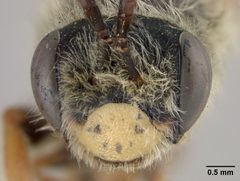
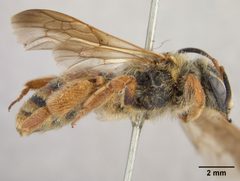
Andrena prunorum is placed in subgenus Plastandrena. Specific diagnostic features distinguishing it from other Andrena are not documented in available sources; identification to species level in this requires specialized examination.
Images
Habitat
Ground-nesting in soil; observed in grasslands containing vernal pools and areas with suitable soil substrate for excavation.
Distribution
North America and Central America; specifically documented from Washington State and widespread across the continental United States.
Seasonality
Spring-flying; active when flowers are blooming.
Diet
Collects pollen and nectar; has been observed to prefer pollen from Rosaceae plants and will pollinate fruit trees when available.
Life Cycle
Females dig tunnels straight into the ground for a few inches, then excavate side tunnels ending in chambers approximately 1 cm wide and 2 cm tall. Chambers are coated with a waxy substance, then provisioned with a pollen-nectar ball 6–8 mm across. A single is deposited per chamber, which is then sealed. Larvae consume the pollen ball, into in autumn, and overwinter as before emerging the following spring. Females construct 8–10 chambers per nest.
Behavior
Solitary nesting with no division of labor; each female constructs and provisions her own nest. Females perform orientation in a rough figure-eight pattern when locating nests. Males patrol areas near cultivated fruit trees before and after bloom to locate receptive females.
Ecological Role
of spring-blooming plants, particularly Rosaceae .
Human Relevance
May contribute to pollination of cultivated fruit trees.
Similar Taxa
- Other Andrena speciesAndrena is a large with many morphologically similar mining bees; A. prunorum is not readily identifiable without specialized examination.
Sources and further reading
- BugGuide
- Wikipedia
- GBIF taxonomy match
- iNaturalist taxon
- NCBI Taxonomy
- Catalogue of Life
- Not-so Solitary Bees - Buglife Blog - Buglife
- Northern Ireland, invertebrate finds in review 2023 - Buglife Blog - Buglife
- In a New Study, Spring Forest Bees Get Their Due
- Bare ground experiments to help save rare bees and wasps - Buglife Blog - Buglife
- What’s in a name….? - Buglife Blog - Buglife
- Bees of the Changing Chalk Partnership Area - Buglife Blog - Buglife
- Observations on the Nesting Biology of Andrena (Plastandrena) Prunorum Cockerell in Washington State (Hymenoptera: Andrenidae)