
Andrena hippotes
Robertson, 1895
Hippotes's Miner Bee, Orange-legged Miner Bee
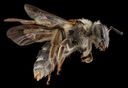
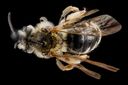
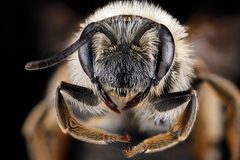
Andrena hippotes is a solitary mining bee in the Andrenidae, commonly known as Hippotes's Miner or Orange-legged Miner Bee. As a member of the Andrena, it is a ground-nesting bee that excavates tunnels in bare soil for nesting. The is found in North America, with records from Vermont and other regions. Like other Andrena species, it is likely active in spring and plays a role in pollination of early-flowering plants.
Pronunciation
How to pronounce Andrena hippotes: /ænˈdriːnə hɪˈpoʊtiːz/
These audio files are automatically generated. While they are not always 100% accurate, they are a good starting point.
Identification
Identification details for Andrena hippotes are not well documented in available sources. As with many Andrena , distinguishing features may include characteristics of the hind legs, facial markings, and patterns. The "Orange-legged Miner " suggests distinctive orange coloration on the legs, though this requires verification. Accurate identification typically requires examination of microscopic features and comparison with or keys.
Images
Habitat
As a ground-nesting mining bee, Andrena hippotes requires bare or sparsely vegetated ground for nesting. Based on the of related Andrena , suitable likely includes areas with exposed soil that receives adequate solar warming, such as south-facing slopes, riverbanks, or disturbed ground. The species has been recorded in Vermont, suggesting for temperate deciduous forest regions.
Distribution
North America. Documented records include Vermont, United States. The full extent of its range within North America is not well characterized in available sources.
Seasonality
Likely spring-active, based on the typical of Andrena . Most mining bees in this emerge and nest in spring, coinciding with the bloom period of early-flowering plants.
Life Cycle
As a solitary , Andrena hippotes has a typical of the : females excavate underground nest tunnels with multiple , provision each cell with pollen and nectar, lay a single per cell, and seal the cells. Larvae develop through the summer, pupate, and overwinter as in the nest before emerging the following spring. Males typically emerge before females.
Ecological Role
More Details
Nomenclature
The was described by Robertson in 1895. The specific epithet 'hippotes' and 'Hippotes's Miner ' honor an individual, though the identity of Hippotes is not specified in available sources. The alternative common name 'Orange-legged Miner Bee' appears in iNaturalist records but its origin and validity are unclear.
Data limitations
Available information on this is sparse. Most sources provide only taxonomic classification and basic distribution data. Detailed ecological studies, morphological descriptions, and behavioral observations appear lacking in the accessible literature.
Sources and further reading
- BugGuide
- Wikipedia
- GBIF taxonomy match
- iNaturalist taxon
- NCBI Taxonomy
- Catalogue of Life
- Not-so Solitary Bees - Buglife Blog - Buglife
- Northern Ireland, invertebrate finds in review 2023 - Buglife Blog - Buglife
- In a New Study, Spring Forest Bees Get Their Due
- Bare ground experiments to help save rare bees and wasps - Buglife Blog - Buglife
- What’s in a name….? - Buglife Blog - Buglife
- Bees of the Changing Chalk Partnership Area - Buglife Blog - Buglife