
Andrena fuscicauda
(Viereck, 1904)
Brown-tailed Miner Bee, Dark-tailed Mining Bee, Dark-tailed Andrena
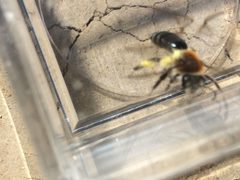
Andrena fuscicauda is a solitary mining bee in the Andrenidae, characterized by its brown or dark-colored tail. As a member of the large Andrena, it exhibits the typical traits of mining bees: ground-nesting , solitary , and spring activity. The is known from North America, though detailed ecological studies specific to this species remain limited.
Pronunciation
How to pronounce Andrena fuscicauda: //ænˈdriːnə fʊsɪˈkaʊdə//
These audio files are automatically generated. While they are not always 100% accurate, they are a good starting point.
Identification
The specific epithet "fuscicauda" (dark-tailed) indicates a key identifying feature: a dark or brownish tail region. This distinguishes it from related Andrena with differently colored or tail sections. Precise identification requires examination of microscopic morphological features typical of the , including facial foveae structure, propodeal sculpturing, and genitalia characteristics. The species is one of approximately 1,400 described Andrena species globally, many of which require expert determination for reliable identification.
Images
Distribution
North America. Distribution records indicate presence across the continent, though specific range boundaries within North America are not well documented.
Seasonality
As a mining bee in the Andrena, activity is expected during spring, consistent with the of most Andrena . Exact period dates are not established.
Life Cycle
As a solitary mining bee, females excavate underground tunnels in soil, provision nest with pollen and nectar, lay , and seal cells. Larvae develop within these cells, pupate, and emerge as the following spring. This pattern is characteristic of the Andrena, though specific details for A. fuscicauda have not been documented.
Ecological Role
As a solitary , likely contributes to pollination of spring-blooming wildflowers. The Andrena is recognized as an important group of native in North American .
Similar Taxa
- Other Andrena speciesAndrena is a large with many morphologically similar . A. fuscicauda is distinguished by its dark tail coloration, but reliable differentiation from requires examination of diagnostic characters.
More Details
Taxonomic note
Described by Viereck in 1904. The is part of the diverse Andrena fauna of North America, which remains incompletely studied.
Data limitations
Available sources provide only basic taxonomic and distributional information. No peer-reviewed ecological or behavioral studies specific to A. fuscicauda were located in the provided context.
Sources and further reading
- BugGuide
- Wikipedia
- GBIF taxonomy match
- iNaturalist taxon
- Catalogue of Life
- Not-so Solitary Bees - Buglife Blog - Buglife
- Northern Ireland, invertebrate finds in review 2023 - Buglife Blog - Buglife
- In a New Study, Spring Forest Bees Get Their Due
- Bare ground experiments to help save rare bees and wasps - Buglife Blog - Buglife
- What’s in a name….? - Buglife Blog - Buglife
- Bees of the Changing Chalk Partnership Area - Buglife Blog - Buglife