
Andrena erythronii
Robertson, 1891
Trout-lily Mining Bee, Trout Lily Bee, Trout-lily Andrena
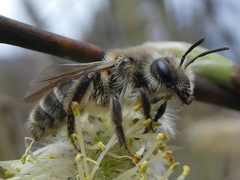
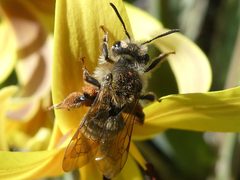
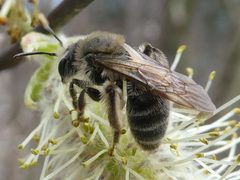
Andrena erythronii is a solitary mining bee native to eastern North America. It is strongly associated with trout lilies (Erythronium), earning its . Females measure 11–14 mm, males 9–11 mm. The has been documented visiting additional spring ephemeral wildflowers and early-flowering trees and shrubs.
Pronunciation
How to pronounce Andrena erythronii: /ænˈdriːnə ɛrɪˈθroʊnaɪ/
These audio files are automatically generated. While they are not always 100% accurate, they are a good starting point.
Identification
Distinguished from other Andrena primarily by its strong phenological and ecological association with trout lily (Erythronium) flowers in early spring. Size range (9–14 mm) overlaps with many ; precise identification likely requires examination of subtle morphological features such as facial fovea structure, clypeal punctation, and genitalia. The reflects this association rather than unique visual characteristics.
Images
Appearance
Females reach 11–14 mm in length; males are smaller at 9–11 mm. As a member of the Andrena, it exhibits the typical mining bee : robust, hairy body with scopae (pollen-collecting hairs) on the hind legs of females. Specific coloration and pattern details are not well documented in available sources.
Habitat
Deciduous forests of eastern North America where trout lilies and other spring ephemerals occur. Requires bare or sparsely vegetated ground for nesting, as is typical for ground-nesting Andrena . Associated with forest understory conditions where spring-blooming herbs are abundant.
Distribution
Eastern North America. Documented from Vermont and broader northeastern United States. GBIF records indicate presence in North America with specific records from Vermont, US.
Seasonality
Active in early spring, coinciding with trout lily bloom period. Has been observed visiting flowers of spring ephemerals including spring beauty (Claytonia), hepatica (Hepatica), and harbinger-of-spring (Erigenia bulbosa), as well as early-flowering shrubs and trees: serviceberry (Amelanchier), plum and cherry (Prunus), and willow (Salix).
Diet
Oligolectic or specialized pollen forager with strong preference for Erythronium (trout lilies); has been observed collecting pollen and nectar from additional spring ephemeral wildflowers and early-flowering woody plants including Claytonia, Hepatica, Erigenia bulbosa, Amelanchier, Prunus, and Salix.
Host Associations
- Erythronium - primary pollen/nectar sourceStrong association giving its
- Claytonia - pollen/nectar sourcespring ephemeral wildflower
- Hepatica - pollen/nectar sourcespring ephemeral wildflower
- Erigenia bulbosa - pollen/nectar sourcespring ephemeral wildflower
- Amelanchier - pollen/nectar sourceearly-flowering shrub/tree
- Prunus - pollen/nectar sourceearly-flowering shrub/tree
- Salix - pollen/nectar sourceearly-flowering tree
Life Cycle
Solitary with typical Andrena : females excavate underground nests in bare soil, provision with pollen and nectar, and lay . Larvae develop in sealed cells. Specific details of voltinism and stage are not documented in available sources.
Behavior
Ground-nesting () solitary . Females excavate tunnels in soil and provision individual with pollen and nectar for larval development. Males emerge before females and patrol nesting areas seeking mates.
Ecological Role
Important of spring ephemeral wildflowers in eastern North American deciduous forests, particularly trout lilies (Erythronium). Contributes to early-season pollination services in forest before closure.
Human Relevance
Of interest to pollination ecologists and conservation biologists studying forest and spring ephemeral pollination dynamics. Not known to be of direct economic importance.
Similar Taxa
- Other Andrena speciesMany overlap in size and general ; A. erythronii distinguished primarily by phenological timing and strong Erythronium association rather than obvious visual differences.
- Other spring-flying mining beesShare and seasonal activity; precise identification requires detailed morphological examination.
More Details
Nesting biology
As a ground-nesting Andrena, requires bare or sparsely vegetated soil for nest excavation. Forest management practices that maintain open understory conditions and prevent dense ground cover may benefit this .
Conservation context
Forest-associated bees like A. erythronii may be sensitive to forest fragmentation and changes in understory composition. The exemplifies the specialized pollination mutualisms between spring ephemerals and early-flying bees in eastern North American forests.
Sources and further reading
- BugGuide
- Wikipedia
- GBIF taxonomy match
- iNaturalist taxon
- NCBI Taxonomy
- Catalogue of Life
- Not-so Solitary Bees - Buglife Blog - Buglife
- Northern Ireland, invertebrate finds in review 2023 - Buglife Blog - Buglife
- In a New Study, Spring Forest Bees Get Their Due
- Bare ground experiments to help save rare bees and wasps - Buglife Blog - Buglife
- What’s in a name….? - Buglife Blog - Buglife
- Bees of the Changing Chalk Partnership Area - Buglife Blog - Buglife