
Ortheziidae
ensign scales, ortheziids
Genus Guides
5- Arctorthezia
- Insignorthezia
- Newsteadia(ensign scale insects)
- Nipponorthezia
- Orthezia
is a of scale insects (Hemiptera) commonly known as ensign , comprising 20 and 198 . The family has a distribution with concentrated in the Neotropical and Nearctic regions; representation is sparse in Australasia and the Far East. Members are distinguished by their mobile females, six legs, and prominent waxy secretions. Several species are economically significant agricultural pests.
Pronunciation
How to pronounce Ortheziidae: //ɔrˈθɛz.i.aɪ.diː//
These audio files are automatically generated. While they are not always 100% accurate, they are a good starting point.
Identification
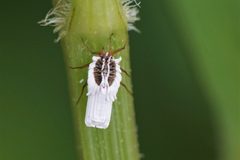
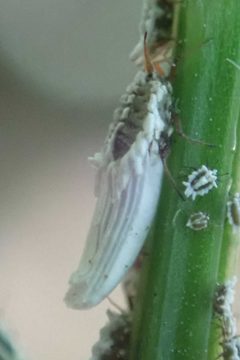
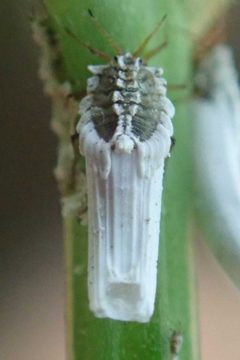
can be distinguished from other insect by the retention of six functional legs and in females, combined with the presence of a thick, fluted waxy covering. The stalked and distinctive antennal setae are additional diagnostic features. The mobile adult female contrasts with the habit of adult female Coccidae and most Pseudococcidae. The Ortheziolinae has been recorded from forest litter in Japan, Korea, Nepal, and Taiwan.
Images
Appearance
females possess six dark-colored legs, a pair of dark with thick terminal bristly setae at the apex, and stalked . The body upper surface is covered by a thick, decorated, fluted waxy secretion. Multiple abdominal are present, along with an anal ring on the surface bearing pores and setae. Adult females remain mobile throughout life, unlike many other insect .
Habitat
Occurs across diverse environments from lowland to montane regions. have been documented in forest litter ( Ortheziolinae), and on living plants including mosses, grasses, herbaceous plants, woody shrubs, and fungi. In Brazil, specimens have been collected from agricultural settings including papaya, pineapple, and coffee plantations.
Distribution
distribution with majority of in Neotropical and Nearctic regions. Sparse representation in Australasia and the Far East. Documented from Central and South America, Caribbean, Africa (including Uganda), Europe (Denmark, Norway, Sweden), and Asia (Japan, Korea, Nepal, Taiwan). The Ortheziolinae was recently recorded for the first time from Japan.
Diet
Phytophagous; feeds on plant sap. range includes mosses, grasses, small herbaceous plants, woody shrubs, and fungi. The citrus orthezia (Praelongorthezia praelonga) is highly .
Host Associations
- Hamelia sphaerocarpa - Documented for Orthezia insignis in Uganda
- Coffea canephora - Collected from coffee in Espírito Santo, Brazil
- Carica papaya - Collected from papaya in Brazil
- Ananas comosus - Collected from pineapple in Brazil
- mosses - General category for
- grasses - General category for
- fungi - General category for
Life Cycle
Females develop through four instars; males typically develop through five instars including non-feeding, mobile prepupal and pupal stages. males are non-feeding. are laid in an ovisac attached to the perimeter of the by a band. time ranges from 40 to 200 days with multiple generations per year possible in some .
Behavior
females are mobile throughout life, unlike the habit typical of many other insect . Males exhibit mobile non-feeding prepupal and pupal stages. Some in Ortheziolinae inhabit forest litter and have been collected using extraction methods.
Ecological Role
Herbivores that extract plant sap; some induce growth (Capnodium sp.) through honeydew , causing indirect plant damage. Some members serve as agricultural pests requiring approaches. Accurate identification is considered essential for development of effective pest management strategies.
Human Relevance
Several are economically significant agricultural pests. The citrus orthezia (Praelongorthezia praelonga) causes direct feeding damage and indirect damage via associated sooty molds; it has been introduced to the Afrotropical region and has potential for further spread. Management approaches include chemical, mechanical, cultural, physical, biological, and methods. Taxonomic expertise is required for accurate identification, with voucher specimens deposited in institutional collections (INCAPER, Bohart Museum, UFSCar).
Similar Taxa
- CoccidaeSoft scales; female Coccidae are typically with reduced or absent legs, contrasting with the mobile, six-legged adult female
- PseudococcidaeMealybugs; while some retain legs, they lack the thick fluted waxy covering and stalked characteristic of ; ovisac structure differs
- MonophlebidaeGiant scales; generally much larger with different waxy covering structure and abdominal segmentation
More Details
Taxonomic composition
contains 20 valid and 198 . Two recognized: Ortheziinae and Ortheziolinae. The latter was first recorded from Japan in 2007 with description of two new species (Ortheziola mizushimai and Ortheziolamameti maeharai).
Invasive potential
Praelongorthezia praelonga is identified as a potential with capacity for establishment in climatically suitable regions beyond its native Neotropical range. Introduction to the Afrotropical region has already occurred.
Sources and further reading
- BugGuide
- Wikipedia
- GBIF taxonomy match
- iNaturalist taxon
- NCBI Taxonomy
- Catalogue of Life
- The citrus orthezia, Praelongorthezia praelonga (Douglas) (Hemiptera: Ortheziidae), a potential invasive species.
- Coccidae, Pseudococcidae, Ortheziidae, and Monophlebidae (Hemiptera: Coccoidea) of Espírito Santo, Brazil
- First records of the subfamily Ortheziolinae (Hemiptera: Ortheziidae) in Japan, with descriptions of two new species
- Aspects of the Biology of Orthezia insignis Browne (Ortheziidae: Homoptera) Infesting Hamelia sphaerocarpa Ruiz & Pav. (Rubiaceae) in Uganda—II