
Kerriidae
Lindinger, 1937
Lac insects, Lac scales
Genus Guides
1- Tachardiella(lac scales)
is a of scale insects in the order Hemiptera, commonly known as lac insects or lac scales. Members secrete a protective waxy resin called lac, which is commercially harvested and processed into , dyes, food glazes, and wood finishes. The family includes economically important such as Kerria, Tachardina, and Paratachardina, with Kerria lacca being the most widely cultivated for lac production. Some species have become pests outside their native ranges, while others are valued for their role in sustainable agroecosystems.
Pronunciation
How to pronounce Kerriidae: //ˈkɛri.aɪ.iː//
These audio files are automatically generated. While they are not always 100% accurate, they are a good starting point.
Identification
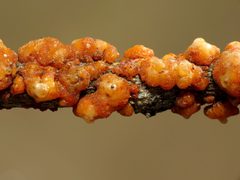
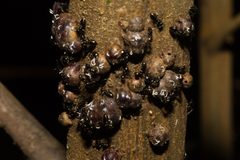
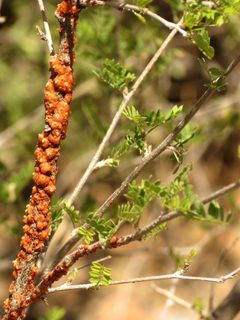
Distinguished from other insect by the copious secretion of lac resin that forms a hard, protective covering. Lobate lac scale (Paratachardina lobata) can be identified by its characteristic lobed, star-shaped appearance. True lac scale (Kerria lacca) forms rounded, encrusting colonies on branches. Molecular identification may be necessary for -level determination where morphological characters overlap. Presence of associated attendants can indicate in field settings.
Images
Habitat
Tropical and subtropical regions; found on woody plants including legumes (Dalbergia, Pongamia), figs (Ficus), and various trees and shrubs. Cultivated lac insects are raised on plantation host trees in mountainous areas with distinct wet and dry seasons. Native occur in forested and woodland .
Distribution
Native to South and Southeast Asia (India, Thailand, China, Indonesia, Malaysia); introduced established in Florida (USA) and other regions. Commercial concentrated in India, China, and Thailand. Some have become outside native range.
Seasonality
Activity and lac production influenced by monsoon patterns in native range; larval development peaks during rainy seasons. In , lac is harvested seasonally, with specific timing varying by region and plant . Multiple per year possible in tropical climates.
Diet
Phytophagous; feeds on phloem sap of plants. Specific host associations documented for cultivated include Dalbergia obtusifolia, Ficus semicordata, Dalbergia szemaoensis, Pongamia pinnata, and various other woody plants.
Host Associations
- Dalbergia obtusifolia - plantPrimary for Kerria yunnanensis in Yunnan, China
- Ficus semicordata - plant for Kerria yunnanensis
- Dalbergia szemaoensis - plant for Kerria yunnanensis
- Pongamia pinnata - plant for Paratachardina lobata in India
- Dalbergia cochinchinensis - plant for Kerria nepalensis in China
- Adenostoma sp. - plant for Tachardiella sp. in California
- Annona squamosa - plant for Kerria destructor in India
- Peltophorum pterocarpum - plant for Kerria destructor in India
Life Cycle
Hemimetabolous development with . Females produce or live young (ovoviviparity in some ). First-instar larvae () are mobile and disperse to new feeding sites; subsequent instars become and secrete lac. Males develop through prepupal and pupal stages within lac . lac contains developing larvae used for inoculation of new trees in .
Behavior
females form dense on branches, facilitating lac harvest. Produce honeydew that attracts mutualists; ant attendance provides protection against and . Some ant construct protective shelters over lac insect colonies. Colonial aggregation enhances lac resin production and reduces individual desiccation risk.
Ecological Role
Primary consumers in plant-based ; serve as for diverse including encyrtids (Tachardiaephagus, Ooencyrtus), eulophids (Aprostocetus), and aphelinids (Coccophagus, Marietta). Mutualism with ants creates complex multi- interactions. Cultivated species support organic agroecosystems where use is restricted. (e.g., Paratachardina lobata in Florida) threaten native and economic plants.
Human Relevance
Source of commercial lac and , with production valued at approximately US$92 million in China alone. Lac used in food glazes, cosmetics, pharmaceuticals, wood finishes, and traditional dyes. provides rural livelihoods in South and Southeast Asia. Some are pests requiring ; from native ranges have been evaluated and released for control of invasive .
Similar Taxa
- Coccidae (soft scales)Also produce waxy coverings but lack the distinctive hard lac resin secretion; honeydew production differs
- Diaspididae (armored scales)Produce hard protective coverings (tests) but from and wax, not resinous lac; tests are separable from body
- Pseudococcidae (mealybugs)Produce powdery wax but remain mobile as ; lack habit and lac resin production
More Details
Commercial cultivation
Kerria lacca is the most important commercial , with systems involving tree management, lac inoculation, and seasonal harvest. Production requires maintenance of mutualists for pest control.
Invasive species management
Paratachardina lobata (lobate lac ) became in Florida in the early 2000s, attacking over 300 plant . programs have introduced from India, including Aprostocetus bangaloricus and Ooencyrtus kerriae.
Parasitoid complex
Lac insects diverse chalcidoid . Primary parasitoids include Tachardiaephagus tachardiae ( in some regions), Tachardiaephagus somervilli, and -specific encyrtids; secondary parasitoids and hyperparasitoids (e.g., Marietta leopardina) also occur.
Sources and further reading
- BugGuide
- Wikipedia
- GBIF taxonomy match
- iNaturalist taxon
- Catalogue of Life
- Publications | Entomology Research Museum
- HOST ACCEPTANCE TRIALS OF KERRIA LACCA (KERRIIDAE) PARASITOIDS FROM NORTHERN THAILAND ON THE PEST LOBATE LAC SCALE (PARATACHARDINA LOBATA) (KERRIIDAE)
- Multiple Ant Species Tending Lac Insect Kerria yunnanensis (Hemiptera: Kerriidae) Provide Asymmetric Protection against Parasitoids
- A review of Tachardiobius (Hymenoptera: Encyrtidae), with description of a new species from California, USA, a parasitoid of Tachardiella spp. (Hemiptera: Kerriidae)
- First record of the lac-producing species Kerria nepalensis Varshney (Hemiptera, Kerriidae) from China, with a key to Chinese species
- A new species ofCoccophagus(Hymenoptera: Aphelinidae), a parasitoid of lac insects (Hemiptera: Kerriidae) in Indonesia and Malaysia
- First record of Tachardiaephagus tachardiae (Howard, 1896) (Hymenoptera, Chalcidoidea, Encyrtidae) from an invasive Lac insect, Kerria destructor Talukder and Das, 2020 (Hemiptera, Kerriidae)
- Parasitoids of Paratachardina lobata (Hem., Kerriidae): surveys for biological control of the invasive lobate lac scale
- HOST ACCEPTANCE TRIALS OF PARASITOIDS FROM INDIAN PARATACHARDINA LOBATA (HEMIPTERA: KERRIIDAE) ON THE INVASIVE LOBATE LAC SCALE IN FLORIDA
- Production and export of the parasitoid Tachardiaephagus somervilli (Chalcidoidea: Encyrtidae), a biological control agent for the yellow lac scale, Tachardina aurantiaca (Hemiptera: Coccoidea: Kerriidae)