
Pellaea
Link, 1841
cliffbrakes
Species Guides
1Pellaea is a of ferns in the Cheilanthoideae of the Pteridaceae, commonly known as cliffbrakes. The genus name derives from Greek 'pellos' meaning 'dark,' referring to the bluish-gray stems characteristic of many . These ferns are primarily adapted to rocky , including cliff , rocky slopes, and bluffs. Molecular phylogenetic studies using chloroplast restriction site variation have clarified relationships within the genus, particularly resolving the P. glabella complex and establishing that P. atropurpurea is sister to this complex rather than the previously hypothesized P. breweri.
Pronunciation
How to pronounce Pellaea: /pɛˈliːə/
These audio files are automatically generated. While they are not always 100% accurate, they are a good starting point.
Identification
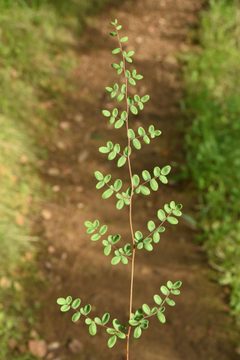
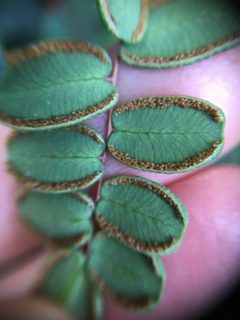
Members of Pellaea can be distinguished from other cheilanthoid ferns by their typically dark (bluish-gray to purplish-brown) stems and rachises. within the show considerable morphological variation, with some exhibiting dimorphic fertile and sterile fronds. P. atropurpurea is distinguished by its distinctly pubescent, purplish-brown rachis and dimorphic leaves with narrowly elongate fertile leaflets bearing sporangia along curled margins and broader, T-shaped sterile leaflets. P. glabella has a smooth (glabrous) rachis and is less commonly found growing in soil, typically restricted to exposed rock surfaces.
Images
Habitat
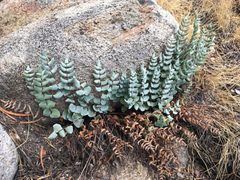
Primarily rocky including moist rocky canyons, slopes, bluffs, and cliff . While the is generally considered xeric-adapted, individual show habitat variation—P. glabella has been documented from atypical moist, shaded, north-facing limestone cliffs. P. atropurpurea and P. glabella frequently co-occur on north-facing dolomite bluffs in dry-mesic deciduous upland forest.
Distribution
North America, with documented occurrences in the United States (including the Ozarks, Oklahoma, Ohio) and Canada (Alberta and broader Canadian distribution). P. glabella occurs scattered throughout the Ozarks and a few northern counties. The represents a primarily North American group within the cheilanthoid ferns.
Ecological Role
Cliffbrake ferns contribute to plant diversity on rocky substrates and cliff , often forming part of diverse fern on north-facing bluffs. They serve as plants for specialized herbivores including the fern-feeding agromyzid fly Phytoliriomyza felti, whose leaf mines have been documented on P. atropurpurea.
Human Relevance
Collected by botanists and naturalists; subject of phylogenetic and taxonomic research. Some cultivated despite sporadic natural occurrence.
Similar Taxa
- AspleniumBoth include found on rocky substrates and north-facing bluffs; Asplenium rhizophyllum (American fern) and A. platyneuron (ebony spleenwort) frequently co-occur with Pellaea species. Distinguished by spleenworts typically having green rather than dark stems and different leaflet arrangements.
- CystopterisCystopteris bulbifera (bulblet fern) shares rocky cliff and can co-occur on dolomite bluffs; distinguished by brown winter foliage, bulblets on leaf undersides for , and greenish rather than dark stems.
- WoodsiaAnother cliff-dwelling fern in similar ; molecular studies indicate Woodsia is more distantly related within cheilanthoids, and lack the characteristic dark stems of Pellaea.
Sources and further reading
- BugGuide
- Wikipedia
- iNaturalist taxon
- NCBI Taxonomy
- Catalogue of Life
- Botanizing at Meramec State Park, Natural Wonders Trail | Beetles In The Bush
- Ted C. MacRae | Beetles In The Bush | Page 5
- The Distribution of Pellaea in Canada
- CHLOROPLAST DNA RESTRICTION SITE VARIATION IN THE FERN GENUS PELLAEA: PHYLOGENETIC RELATIONSHIPS OF THE PELLAEA GLABELLA COMPLEX
- An Unusual Habitat for Pellaea glabella
- Taxonomy, distribution, and ecology of the cliff-brake ferns (Pellaea: Polypodiaceae) in Alberta