
Chilacis typhae
(Perris, 1857)
bulrush bug
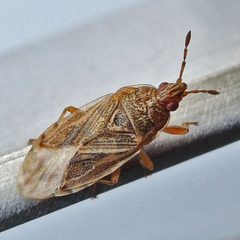
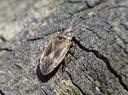
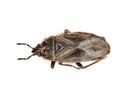
Chilacis typhae is a small seed-sucking true in the Artheneidae. It is tightly associated with cattails (Typha ), particularly greater reedmace (Typha latifolia) and Typha angustifolia, where it feeds on developing seeds. The species harbors an obligate intracellular bacterial endosymbiont, "Candidatus Rohrkolberia cinguli," housed in a distinctive "mycetocytic belt" in the epithelium. Native to Europe and Northern Asia, it has been introduced to North America.
Pronunciation
How to pronounce Chilacis typhae: /ˈkɪləsɪs ˈtɪfi/
These audio files are automatically generated. While they are not always 100% accurate, they are a good starting point.
Identification
Small, elongate-oval true with a somewhat flattened body. The is most reliably identified by its exclusive association with Typha seed ; are often found in mating pairs on the dense, brownish seed heads. Detailed morphological diagnostic features distinguishing it from are not provided in available sources.
Images
Habitat
Strictly associated with wetlands and margins of standing water where cattails (Typha latifolia, Typha angustifolia) grow. and nymphs inhabit the seed , often remaining within them through winter.
Distribution
Native to Europe and Northern Asia (excluding China). Introduced to North America, with established in the United States and Canada. Specific countries with records include: Belgium, Bulgaria, Czech Republic, Finland, France, England, Germany, Hungary, Ireland, Poland, Romania, Russia, Sweden, Switzerland, Austria, Bosnia, Belarus, Denmark, Estonia, Italy, Moldova, Slovakia, Slovenia, Ukraine, Azerbaijan, Kazakhstan, Kyrgyzstan, Uzbekistan, Jordan, Caucasus region, and Astrakhan (Russia).
Seasonality
are active from spring through autumn. They often overwinter within Typha seed , suggesting year-round presence in suitable .
Diet
Feeds on seeds of Typha latifolia (greater reedmace) and Typha angustifolia. A monophagous seed-sucking .
Host Associations
- Typha latifolia - obligate plantprimary food source; feed on seeds
- Typha angustifolia - obligate plantprimary food source
- "Candidatus Rohrkolberia cinguli" - obligate intracellular endosymbionthoused in mycetocytic belt at end of first section; transmitted vertically through poles
Life Cycle
with , nymph, and stages. Endosymbionts are transmitted vertically to offspring, detected at poles of developing eggs. Nymphs and adults both inhabit Typha seed .
Behavior
frequently found in mating pairs on seed . Capable of forming dense ; over 1000 individuals have been recorded in a single seed head. Overwinters within seed heads, suggesting limited during cold periods.
Ecological Role
seed of Typha, potentially influencing cattail seed set and in dense . Serves as for obligate bacterial endosymbiont representing an evolutionarily intermediate symbiotic structure among Heteroptera.
Human Relevance
No direct economic or medical significance reported. Presence in North America is due to human-mediated introduction. Dense may occasionally attract attention from naturalists or wetland managers.
Similar Taxa
- Other Chilacis species may overlap in range but differ in plant specificity; C. typhae is distinguished by strict association with Typha
- Other Artheneidae members are generally small, seed-feeding associated with grasses or sedges; plant association is primary distinguishing feature
More Details
Endosymbiont biology
The mycetocytic belt of C. typhae represents a structurally unique symbiotic organ among Heteroptera—intermediate between typical extracellular crypts and intracellular mycetomes. The "Candidatus Rohrkolberia cinguli" belongs to Gammaproteobacteria and shows phylogenetic affinity with secondary symbionts of bed bugs (Cimex lectularius) and plant (Pectobacterium, Dickeya).
Population density
Extremely high local densities have been documented, with over 1000 individuals recorded from a single Typha seed , indicating strong and effective exploitation of patchy plant resources.