
Hypselonotus
Hahn, 1833
Species Guides
2- Hypselonotus lineatus
- Hypselonotus punctiventris(Spot-sided Coreid)
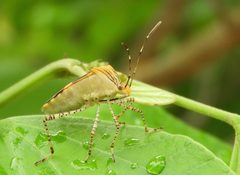
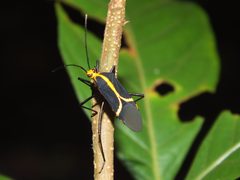
Hypselonotus is a of leaf-footed bugs in the Coreidae, containing approximately 12 described . Members of this genus are found in the Americas, with records from Mexico through Central America to Argentina. The genus is characterized by notable intraspecific color variation, as documented in species such as Hypselonotus interruptus, which exhibits a broad range of color forms from pale with red markings to heavily melanized individuals. Species identification relies on small femoral spines and characters, though the genus would benefit from molecular systematic revision.

Pronunciation
How to pronounce Hypselonotus: /hɪpˌsɛloʊˈnoʊtəs/
These audio files are automatically generated. While they are not always 100% accurate, they are a good starting point.
Identification
-level identification in Hypselonotus requires examination of small femoral spines and characters; coloration alone is unreliable due to extensive intraspecific variation. The can be distinguished from other Coreidae by the combination of ocelli presence, forewing with numerous arising from a transverse basal vein, and metathoracic opening structure. Hypselonotus interruptus specifically shows complex color including pale forms with yellow pronotal lines and red triangular markings, as well as heavily melanized variants.
Images
Habitat
Associated with flowering vegetation; observed on ornamental shrubs in tropical and subtropical regions. Specific plant relationships are not well documented.
Distribution
Mexico; Central America; South America (Argentina Northeast, Argentina Northwest); United States (Arizona, Arkansas).
Behavior
Observed visiting flowers in numbers, suggesting nectar-feeding or pollen-associated . Individuals have been noted to be conspicuous and relatively approachable on flowering vegetation.
Similar Taxa
- PyrrhocoridaeSimilar aposematic coloration in some Hypselonotus , but distinguished by presence of ocelli in Hypselonotus (absent in Pyrrhocoridae) and forewing venation pattern.
- LygaeidaeShared presence of ocelli and some superficial similarities, but distinguished by forewing venation and metathoracic structure in Hypselonotus.
Sources and further reading
- BugGuide
- Wikipedia
- GBIF taxonomy match
- iNaturalist taxon
- NCBI Taxonomy
- Catalogue of Life
- Brazil Bugs #4 – Mais dos percevejos | Beetles In The Bush
- Brazil Bugs #1 | Beetles In The Bush
- Survival and Growth of Sumatran Featherback (Chitala hypselonotus, Bleeker 1852) Reared on Net Cages
- Desiminasi dan Demplot Domestikasi Ikan Belida Sumatera (Chitala hypselonotus) di Desa Burai, Kecamatan Tanjung Batu, Kabupaten Ogan Ilir
- Study on morphometric-meristic characteristics, growth patterns and condition factors of the Sumatran featherback (Chitala hypselonotus, Bleeker 1852) from the Kelekar River in South Sumatra, Indonesia