
Belostoma lutarium
(Stål, 1856)
giant water bug
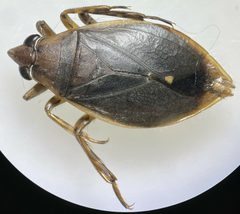
Belostoma lutarium is a of giant water bug in the Belostomatidae, native to North America. This aquatic insect is notable for its distinctive paternal care , in which males carry clutches on their backs until hatching—a rare form of male in insects. The species exhibits with females being the larger sex, and studies suggest males may be the choosier sex in mate selection. As a , it feeds on aquatic , small fish, and amphibian larvae including tadpoles.
Pronunciation
How to pronounce Belostoma lutarium: //ˌbɛloʊˈstoʊmə luˈtɛəriəm//
These audio files are automatically generated. While they are not always 100% accurate, they are a good starting point.
Identification
Distinguished from other giant water bugs by male -carrying (paternal care) and documented with female-biased size. Specific diagnostic morphological features not detailed in available sources; would require examination of genitalia or detailed measurements to separate from . Presence in North American aquatic with documented on Bufo woodhousii tadpoles may aid field identification.
Images
Appearance
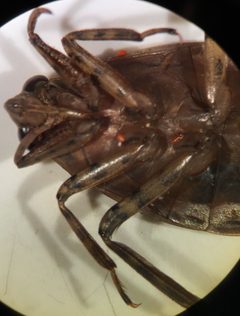
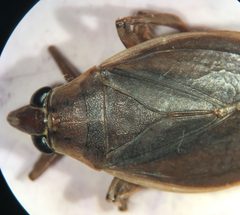
Large aquatic true with flattened, oval body typical of giant water bugs. front legs adapted for grasping prey. Males carry visible clutches cemented to their backs during breeding season. present: females are larger than males. Coloration and detailed morphological measurements not specified in available sources.
Habitat
Freshwater aquatic environments including ponds and slowly moving waters. Specific microhabitat preferences (vegetation type, depth, substrate) not documented in available sources.
Distribution
North America. Specific range boundaries within North America not detailed in available sources.
Diet
of aquatic animals including tadpoles of Bufo woodhousii (Woodhouse's toad). General diet likely includes other aquatic and small vertebrates typical of the , but specific feeding habits beyond tadpole not documented in available sources.
Life Cycle
Males provide paternal care by carrying clutches on their backs until hatching. Detailed developmental stages (egg, nymphal instars, ) not specified in available sources. Duration of egg carrying and nymphal development periods not documented.
Behavior
Exhibits paternal parental care: males carry clutches cemented to their backs, a rare form of male investment in insects. Males appear to be the choosier sex in mate choice, with heavier females more likely to mate than smaller females. Engages in predatory toward tadpoles, with documented behavioral interactions including active pursuit and capture. No evidence from available sources linking male or female traits to offspring survival in the absence of egg .
Ecological Role
in freshwater aquatic , documented to prey upon amphibian larvae (tadpoles). Potential role as top predator in pond ; specific ecosystem functions beyond not detailed in available sources.
Human Relevance
Like other giant water bugs, capable of delivering painful defensive bite if handled carelessly due to and injected digestive saliva. Not documented as a significant pest or beneficial in available sources. No status reported.
Similar Taxa
- Lethocerus spp.Other giant water bugs in same superfamily (Nepoidea) with similar size and aquatic predatory habits, but Lethocerus are generally larger and lack the male -carrying characteristic of Belostoma
- Other Belostoma species share male -carrying paternal care ; specific distinguishing features for B. lutarium not detailed in available sources and would require expert examination
More Details
Paternal Care and Sexual Selection
Research on B. lutarium has contributed to understanding sex role evolution: males carry on their backs (paternal care), females are larger (), and males may be the choosier sex in mate selection—patterns that contrast with typical expectations of theory where females are usually the choosier sex.
Research Significance
This has been used as a model organism in studies of parental care evolution and dynamics, particularly for investigating how paternal care influences mate choice and sex-specific selection pressures.
Sources and further reading
- BugGuide
- Wikipedia
- GBIF taxonomy match
- iNaturalist taxon
- NCBI Taxonomy
- Catalogue of Life
- Faces in the Crowd at the Bohart Museum Open House | Bug Squad
- Belostomatidae | Beetles In The Bush
- So, how big do insects get? - Buglife Blog - Buglife
- How a giant water bug reached the island of Cyprus
- Uncategorized | Blog - Part 33
- Not a Kissing Bug: Invasive Western Conifer-Seed Bug Causes Undue Alarm
- Parental Care and Mate Choice in the Giant Water Bug Belostoma lutarium
- BEHAVIORAL INTERACTIONS BETWEEN THE GIANT WATER BUG (BELOSTOMA LUTARIUM) AND TADPOLES OF BUFO WOODHOUSII