
Stenolemus
Signoret, 1858
Spider Assassin Bugs
Species Guides
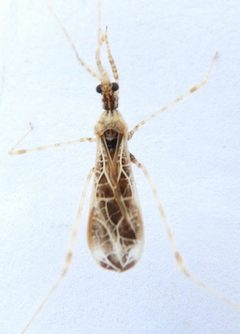
5Stenolemus is a of thread-legged assassin bugs (Emesinae) characterized by specialized araneophagy— on spiders. in this genus exhibit diverse hunting strategies, including web invasion and exploitation of spider draglines as prey location cues. The genus has a broad geographic distribution spanning Australia, Asia, and the Pacific region. Multiple species have been described, with S. bituberus and S. giraffa being the most extensively studied for their predatory and .
Pronunciation
How to pronounce Stenolemus: //ˌstɛnoʊˈliːməs//
These audio files are automatically generated. While they are not always 100% accurate, they are a good starting point.
Identification
Members of Stenolemus can be distinguished from other Emesinae by their association with spider webs or web-building spiders, a trait not universal in the . The exhibits the elongated, slender body form and reduced wings typical of thread-legged bugs. Specific identification to level requires examination of morphological characters such as body proportions, antennal segmentation, and genitalic structures; the genus is most reliably recognized in the field by its behavioral association with spider webs.
Images
Habitat
Rock escarpments and substrates where web-building spiders are abundant. S. giraffa has been documented specifically on rock escarpments in the Northern Territory and Western Australia. The is found in supporting their spider prey, including various web-building spider .
Distribution
Australia (Northern Territory, Western Australia, and other regions), Japan (Okinawa, Ryukyu Islands), Taiwan, and additional locations across Asia and the Pacific. The distribution of S. alikakay was extended northward to Japan with its discovery in Okinawa.
Diet
Life Cycle
S. bituberus develops through five nymphal instars from to in approximately 60 days at 25°C. The fourth instar is the longest in duration and corresponds to winter months in the field; mortality during this instar is higher than in other stages. in size becomes apparent at the fifth instar, with males showing greater width across the , a pattern continuing into adulthood. Overall, adult females tend to be larger than males.
Behavior
Specialized araneophagic with multiple documented tactics. S. bituberus uses chemotactile cues from spider draglines to locate prey, showing increasing association with draglines through the day. S. giraffa employs stealth-based stalking, approaching spiders by breaking silk threads while beneath webs or hanging directly from them. Predation involves slow, deliberate movement until striking range is achieved. Araneophagy carries significant risk: S. giraffa has been observed being attacked and killed by spiders.
Ecological Role
specialized on web-building spiders. Acts as a significant mortality source for spider in occupied . The contributes to predator-prey dynamics in spider , with potential for top-down effects on spider population structure.
Similar Taxa
- Other Emesinae genera (e.g., Emesaya, Ploiaria)Share thread-legged but lack the specialized araneophagic ; most Emesinae are or have different prey associations
- NagustoidesAnother assassin bug recently recorded from Japan alongside Stenolemus; belongs to Harpactorinae rather than Emesinae, differing in body form and prey associations
More Details
Predatory Risk
Araneophagy in Stenolemus is a dangerous strategy. Field and laboratory observations of S. giraffa document instances where the assassin bug was attacked and sometimes killed by its intended spider prey, indicating strong selection pressure on stealth and approach tactics.
Research Significance
S. bituberus and S. giraffa serve as model organisms for studying chemically-mediated -prey interactions and the evolution of specialized predatory in insects. The provides evidence that araneophagy is prevalent and variable within Emesinae.
Sources and further reading
- BugGuide
- Wikipedia
- GBIF taxonomy match
- iNaturalist taxon
- NCBI Taxonomy
- Catalogue of Life
- The assassin bug genera Nagustoides and Stenolemus (Hemiptera: Heteroptera: Reduviidae) newly recorded from Japan
- Responses of an araneophagic assassin bug, Stenolemus bituberus , to spider draglines
- Growth and development of an araneophagic assassin bug, Stenolemus bituberus (Heteroptera : Reduviidae)
- Biology of Stenolemus giraffa (Hemiptera: Reduviidae), a web invading, araneophagic assassin bug from Australia
- Biology and life history of the araneophagic assassin bugStenolemus bituberusincluding a morphometric analysis of the instars (Heteroptera, Reduviidae)