
Dichrooscytus
Fieber, 1858
Species Guides
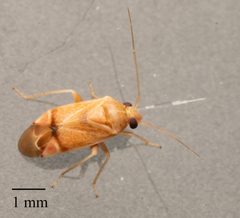
5Dichrooscytus is a of plant bugs ( Miridae) comprising over 70 described . Species occur across North America, Europe, and northern Eurasia, with documented records from Canada, the United States, Mexico, and Scandinavia. The genus includes species associated with coniferous , including the documented association of D. sequoiae with Giant Sequoia (Sequoiadendron giganteum).
Pronunciation
How to pronounce Dichrooscytus: //daɪˈkroʊ.əˌsaɪ.təs//
These audio files are automatically generated. While they are not always 100% accurate, they are a good starting point.
Identification
-level identification in Dichrooscytus relies heavily on examination of male genitalia, which are illustrated in taxonomic revisions. External alone is generally insufficient for reliable species determination within this .
Images
Distribution
North America (Canada: British Columbia, Alberta; United States: California, Arizona, Colorado, New Mexico, Texas; Mexico: Puebla, Durango, Coahuila), Europe (Denmark, Norway, Sweden).
Host Associations
- Sequoiadendron giganteum - Documented for D. sequoiae
More Details
Taxonomic History
The was established by Fieber in 1858. Multiple taxonomic revisions have expanded the known fauna, including descriptions of four new Canadian in 1972, nine new North American species in 1972, and four additional species from New Mexico and Texas in 1972.
Research Needs
plant associations are documented for some but remain unknown for many others. Full text of key taxonomic works would be needed to extract specific host plant data referenced in abstracts.
Sources and further reading
- BugGuide
- Wikipedia
- GBIF taxonomy match
- iNaturalist taxon
- NCBI Taxonomy
- Catalogue of Life
- DESCRIPTIONS OF NINE NEW SPECIES OF DICHROOSCYTUS FROM NORTH AMERICA (HETEROPTERA: MIRIDAE)
- SPECIES OFDICHROOSCYTUSFOUND IN CANADA, WITH DESCRIPTIONS OF FOUR NEW SPECIES (HETEROPTERA: MIRIDAE)
- Giant Sequoia (Sequoiadendron giganteum: Cupressaceae) as a Host of the Plant Bug Dichrooscytus sequoiae Bliven (Hemiptera: Miridae)
- A NOTE ON DICHROOSCYTUS ELEGANS, WITH DESCRIPTIONS OF FOUR NEW SPECIES FROM NEW MEXICO AND TEXAS (HETEROPTERA: MIRIDAE)