
Lyctocoridae
Lyctocorid Pirate Bugs
Genus Guides
1is a of predatory true bugs in the infraorder Cimicomorpha, reconstituted from Anthocoridae based on phylogenetic evidence. Members range from 2–6 mm and exhibit distinctive asymmetrical male genitalia. The family includes the Lyctocoris campestris, known for occasional blood-feeding, and the Japanese L. ichikawai, which uniquely feeds on oak sap. They occupy diverse microhabitats including tree bark, decaying matter, and stored food products.
Pronunciation
How to pronounce Lyctocoridae: /laɪk.toʊˈkɔr.ɪˌdi/
These audio files are automatically generated. While they are not always 100% accurate, they are a good starting point.
Identification
Distinguished from Anthocoridae by male genitalia: left paramere flat, single-sheeted, lacking (Anthocoridae have different paramere structure). Phallus tubular with visible striated ductus seminis and needle-like acus. Females with genital on sternum 7. Overall body form similar to Anthocoridae but phylogenetically distinct.
Images
Appearance
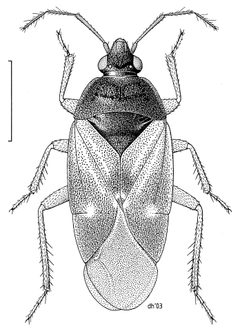
Small 2–6 mm in length. 3-segmented. Forewing with costal fracture and weakly developed . Laterotergites present on all abdominal . Male genitalia strongly asymmetrical: left paramere larger than right, flat and single-sheeted without ; phallus tubular with transversely striated ductus seminis and needle-shaped acus. Females possess genital on region of abdominal sternum 7.
Habitat
Under tree bark; decaying plant matter; animal nests and burrows; manure piles; poultry houses; granaries; stored food products. Lyctocoris ichikawai specifically inhabits sap-exuding regions on trunks of Sawtooth Oak (Quercus acutissima).
Distribution
Widely distributed globally. Lyctocoris campestris is . Lyctocoris ichikawai occurs in Shikoku and Kyushu, southwestern Japan. Related L. zhangi in continental China and L. variegatus in the Caucasus.
Diet
Mostly of small, soft-bodied arthropods. Lyctocoris campestris occasionally feeds on mammal blood, including human. Lyctocoris ichikawai feeds exclusively on exuded sap of Sawtooth Oak (Quercus acutissima). and nymphs share similar diets.
Host Associations
- Quercus acutissima - sap sourceSawtooth Oak; sole known for Lyctocoris ichikawai
Behavior
Practice : male pierces female between 7 and 8 on right using phallus acus. Sperm migrate through haemocoel or specialized structures to ovaries, fertilizing within vitellarium.
Ecological Role
of small arthropods in forest litter, bark, and stored product . Some serve as agents against and pests in stored food products and bark beetle pests.
Human Relevance
Lyctocoris campestris occasionally bites humans. Some used in of stored product pests and bark beetles. Presence in granaries and poultry houses may indicate pest management applications.
Similar Taxa
- AnthocoridaeFormerly classified together; distinguished by male paramere structure, phallus , and female genital
More Details
Taxonomic History
Reconstituted as separate from Anthocoridae based on phylogenetic work. Molecular studies indicate many former constituents (including Dufouriellini and multiple ) remain better placed in Anthocoridae, leaving with reduced generic composition including Lyctocoris and Astemmocoris.
Feeding Specialization
Lyctocoris ichikawai represents a rare case of sap-feeding within the , contrasting with the predominantly predatory habits of and the occasional blood-feeding of L. campestris.