
Cimex adjunctus
Barber, 1939
Eastern Bat Bug
Cimex adjunctus, commonly known as the Eastern Bat Bug, is a temporary of bats found across North America. Unlike the common bed bug (Cimex lectularius), this is specialized on insectivorous bats rather than humans. It feeds on blood but does not remain on its between meals, instead hiding in roosting sites. The species has been documented from multiple bat hosts including the big brown bat (Eptesicus fuscus), Rafinesque's big-eared bat (Corynorhinus rafinesquii), and the Eastern Small-footed Myotis (Myotis leibii). Research indicates that host association influences genetic variation in salivary protein genes, suggesting host-specific .
Pronunciation
How to pronounce Cimex adjunctus: //ˈsiː.mɛks ædˈdʒʌŋk.təs//
These audio files are automatically generated. While they are not always 100% accurate, they are a good starting point.
Identification
Distinguishing Cimex adjunctus from Cimex lectularius (common bed bug) and Cimex pilosellus (western bat bug) requires examination of the pronotum and genitalia. The pronotum shape and setal patterns differ among these . Cimex adjunctus is associated with bats rather than humans, which aids in field identification. When found in buildings, their presence indicates bat roosts rather than human bed bug . Professional entomological identification is recommended for definitive species determination.
Images
Appearance
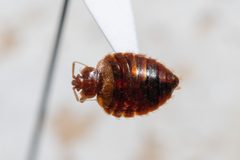
are broadly oval, flattened dorsoventrally, and wingless. The body is reddish-brown to brown in color. Like other Cimex , they possess segmented and a prominent pronotum. The species is morphologically similar to Cimex lectularius and Cimex pilosellus, requiring microscopic examination for definitive identification. Nymphs are smaller versions of adults, tan when unfed and reddish-brown when engorged with blood.
Habitat
Found in bat roosting sites including abandoned houses, maternity colonies, and natural cavities. The occupies the same microhabitats as their bat , hiding in cracks, crevices, and structural voids near roosting bats during periods when not actively feeding.
Distribution
Documented across a wide range of North America. Specific records include Texas (San Jacinto County), Arkansas (Drew County), and Missouri. The has been reported in association with bat colonies throughout its range.
Diet
Obligate blood-feeder; feeds exclusively on the blood of insectivorous bats. Requires blood meals in all life stages except to survive.
Host Associations
- Eptesicus fuscus - Big brown bat; commonly found on wings
- Corynorhinus rafinesquii - Rafinesque's big-eared bat; new record documented in Texas (2009) and Arkansas (2013)
- Myotis leibii - Eastern Small-footed Myotis; new record from Arkansas
Life Cycle
Behavior
Temporary that does not remain on between blood meals. Hides in cracks and crevices near bat roosts when not feeding. feeding activity coincides with host activity patterns. occurs primarily through movement of bats between roosts.
Ecological Role
of bats; linked to bat colony size and stability. Not known to to humans, though related have been investigated for transmission potential.
Human Relevance
Occasionally encountered in buildings with bat . Presence in human dwellings indicates nearby bat roosts rather than independent human . Can be mistaken for bed bugs, causing concern, but does not establish persistent infestations on humans. Management requires bat exclusion rather than conventional bed bug treatments.
Similar Taxa
- Cimex lectulariusCommon bed bug; morphologically similar but associated with humans rather than bats; requires microscopic examination to distinguish
- Cimex pilosellusWestern bat bug; another bat-associated with overlapping ; geographic distribution and associations may aid separation
- Cimex hemipterusTropical bed bug; human-associated found in warmer regions; not known to parasitize bats
Misconceptions
Often mistaken for bed bugs when found in buildings, leading to unnecessary pest control treatments. Unlike Cimex lectularius, this does not establish persistent on humans and will not reproduce without access to bat . Proper identification is essential to avoid inappropriate management approaches.
More Details
Host-Associated Genetic Variation
Research has demonstrated that of Cimex adjunctus associated with different bat show greater genetic variation at salivary protein genes (apyrase and nitrophorin) than populations from different geographic locations on the same host species. This suggests host-specific selection pressures on genes involved in blood-feeding.
Bat Bug vs. Bed Bug Management
in human structures require identification of the source bat colony and its exclusion from the building. Without bat , Cimex adjunctus cannot sustain themselves. Chemical treatments alone are ineffective if bats remain present.
Sources and further reading
- BugGuide
- Wikipedia
- GBIF taxonomy match
- iNaturalist taxon
- NCBI Taxonomy
- Catalogue of Life
- Avoiding bed bug blues - Common bed bug, Cimex lectularius (MISSING VIDEO AND LINK) — Bug of the Week
- Organic Dust Takes a Bite Out of Ticks
- Bed Bug of the Week, Cimex lectularius — Bug of the Week
- Bed bugs in the news, Cimex lectularius — Bug of the Week
- Ectoparasites go to school: Bed Bugs in DC, Cimex lectularius — Bug of the Week
- Research Confirms First Bed Bug Infestation in Costa Rica in Over 20 Years
- Host association influences variation at salivary protein genes in the bat ectoparasite Cimex adjunctus
- New Host and Location Record for the Bat Bug Cimex adjunctus Barber 1939, with a Summary of Previous Records
- A New Host Record for the Bat Bug, Cimex adjunctus (Insecta: Hemiptera) from Eastern Small-footed Myotis, Myotis leibii (Chiroptera: Vespertilionidae)
- New Missouri County Records and Review of the Distribution and Disease Vector Potential of Ornithodoros Kelleyi (Arachnida: Ixodida: Argasidae) and Cimex Adjunctus (Insecta: Hemiptera: Cimicidae)