
Hexatoma
Latreille, 1809
Species Guides
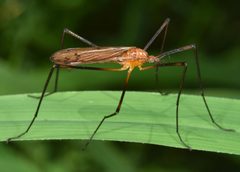
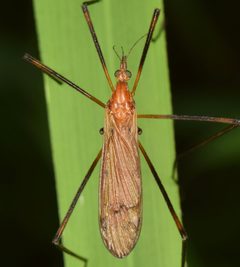
7Hexatoma is a large of short-palped crane flies (Diptera: Limoniidae) comprising approximately 596 extant with worldwide distribution. The genus is divided into six subgenera, with H. (Eriocera) being the most species-rich, containing 556 species. Species are medium-sized to large crane flies (body length 6.5–32.0 mm, wing length 7.5–21.0 mm) characterized by sexually dimorphic , with males typically bearing longer antennae than females. The genus is particularly diverse in Asia, where 362 species occur.
Pronunciation
How to pronounce Hexatoma: //hɛkˈsætəmə//
These audio files are automatically generated. While they are not always 100% accurate, they are a good starting point.
Identification
Hexatoma can be distinguished from other Limoniidae by their short palpi and sexually dimorphic : males have longer antennae (often 6-7 segmented, sometimes several times body length) while females have shorter antennae (8-11 segmented). Male terminalia feature wide epandrium, elongate gonocoxite, two pairs of gonostyli, and simple . Ovipositor typically has long narrow and hypovalvae. Wing patterns vary from patternless to distinct dark coloration with light 'windows'. Larval identification relies on microscopic setae on the last abdominal segment, maxillary palpus length, spiracular field , spiracular lobe length, and labral sensory structure arrangement. Pupal identification uses respiratory horn shape and length, cephalic crest horn size and number, antennal length, leg sheath lengths, and antennal scape characteristics.
Images
Habitat
Larvae develop in aquatic environments, specifically in rivers with sandy or gravel bottoms; some Nearctic develop in bogs. Last instar larvae and pupae occur in the riparian zone, typically in gravel, sand, or under stones. are collected in forests, mountains, river valleys, and temple areas.
Distribution
Worldwide distribution with highest diversity in Asia (362 ). Recorded from the Korean Peninsula, Japan, China, Taiwan, Russia (East Palaearctic including Siberia, Buryatia, Kemerovo Province, Republic of Altai, Krasnoyarsk Territory, Irkutsk Province), Mongolia, and Europe. Elevation range spans 30–650 m above sea level across landscape-climatic zones from forest to dry steppe.
Life Cycle
Holometabolous with aquatic larval and pupal stages. Larvae develop in running waters with sandy or gravel substrates. have been reared from larvae collected in rivers.
Behavior
Males swarm above water surfaces during mating. are attracted to light sources and collected using insect nets, , LED light traps, black light traps, Mosquito Magnet traps, and New Jersey traps. Activity periods vary by .
Ecological Role
Larvae function as decomposers in aquatic , contributing to nutrient cycling.
Sources and further reading
- BugGuide
- Wikipedia
- GBIF taxonomy match
- iNaturalist taxon
- NCBI Taxonomy
- Catalogue of Life
- Review of the last instar larvae and pupae of Hexatoma (Eriocera) and Hexatoma (Hexatoma) (Diptera, Limoniidae, Limnophilinae)
- Hexatoma crane flies (Diptera, Limoniidae) of Korea
- Immature Stages of Genus Hexatoma (Diptera, Limoniidae) in the Korean Peninsula
- <p class="HeadingRunIn"><strong>Distribution of <em>Hexatoma</em> (<em>Eriocera</em>) <em>ussuriensis</em> Alexander (Diptera: Limoniidae)</strong></p>