
Stictomyia
Bigot, 1885
Species Guides
2- Stictomyia longicornis
- Stictomyia punctata(picture-winged fly)
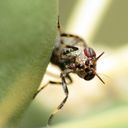
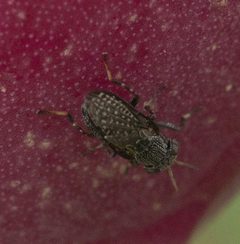
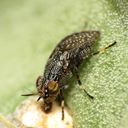
Stictomyia is a small of picture-winged flies ( Ulidiidae) containing two described . The genus is notable for its highly unusual and , particularly in Stictomyia longicornis, which exhibits -like appearance and strong association with cacti. These flies are among the more aberrant members of the Ulidiidae, departing significantly from the typical wing-patterned, active-flying form of most picture-winged flies.
Pronunciation
How to pronounce Stictomyia: /stɪkˈtoʊ.mi.a/
These audio files are automatically generated. While they are not always 100% accurate, they are a good starting point.
Identification
Distinguished from other Ulidiidae by the combination of short wings held flat against the body, compact -like form, and long . Most picture-winged flies have elongated wings with bold patterns held away from the body at rest. Stictomyia superficially resemble small beetles or true bugs (Hemiptera) and are unlikely to be recognized as flies without close examination.
Images
Habitat
Strongly associated with prickly-pear cacti (Opuntia ) in arid and semi-arid regions. occur on cactus pads and among spines; larvae develop in rotting cactus tissue.
Distribution
Southwestern United States, with records from Colorado and Arizona. Distribution corresponds to the range of cacti; potentially extends elsewhere where cacti occur.
Diet
Larvae feed in rotting pads of prickly-pear cactus. feeding habits are not documented.
Host Associations
- Opuntia - larval development in rotting cactus padsprickly-pear cacti
Life Cycle
Larval stage develops in decaying cactus pads. Details of deposition, , and longevity are not documented.
Behavior
are reluctant fliers, preferring to move by and dodging between cactus spines. When disturbed, they evade capture by rapid movement through spiny vegetation rather than taking .
Ecological Role
Contributes to decomposition of rotting cactus tissue. Serves as a specialized decomposer in cactus-dominated .
Human Relevance
No known economic or medical importance. Occasionally encountered by cactus enthusiasts or field biologists in the southwestern United States.
Similar Taxa
- Other UlidiidaeTypical picture-winged flies have elongated, patterned wings held away from the body at rest and active ; Stictomyia has short, appressed wings and reduced flight.
- Small beetles (Coleoptera)Compact body, short wing covers, and crawling create strong superficial resemblance; examination of wing structure and reveals dipteran identity.
- True bugs (Hemiptera)Flattened body form and wing posture similar to some small Hemiptera; lacks and of true bugs.
More Details
Morphological aberration
Stictomyia longicornis is described as one of the more bizarre picture-winged flies due to its extreme departure from -typical . The short, appressed wings and -like form represent a rare evolutionary trajectory within Ulidiidae, likely associated with its specialized cactus-dwelling .
Species diversity
The contains only two described : Stictomyia longicornis Bigot, 1885 and Stictomyia punctata Coquillett, 1900. Most available information pertains to S. longicornis; S. punctata is poorly documented in accessible literature.