
Sepsisoma flavescens
Johnson, 1900
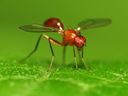
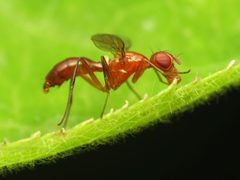
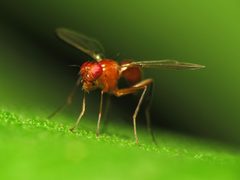
Sepsisoma flavescens is a of fly in the Richardiidae, described by Johnson in 1900. It is one of approximately 14 species in the Sepsisoma. Richardiidae is a family of acalyptrate flies within the order Diptera, commonly known as picture-winged flies due to their patterned wings. Very little specific biological information is documented for this particular species.
Pronunciation
How to pronounce Sepsisoma flavescens: /ˌsɛp.sɪˈsoʊ.mə fləˈvɛs.ɛns/
These audio files are automatically generated. While they are not always 100% accurate, they are a good starting point.
Identification
Members of the Sepsisoma can be distinguished from other Richardiidae by their characteristic wing venation and body proportions. -level identification within Sepsisoma requires examination of detailed morphological features including genitalia structure and specific wing patterns. S. flavescens can be separated from by its yellowish coloration, as indicated by the specific epithet 'flavescens' (meaning becoming yellow).
Images
Similar Taxa
- Other Sepsisoma species share the same general body plan and wing structure, requiring detailed examination of genitalia and coloration patterns for accurate separation.
- Other Richardiidae generaRelated in the same share the acalyptrate body form and picture-winged appearance, but differ in wing venation patterns and body proportions.
More Details
Taxonomic placement
Richardiidae is placed in the superfamily Tephritoidea within the suborder of Diptera. The contains approximately 30 and 175 , primarily distributed in the Neotropical region.
Etymology
The specific epithet 'flavescens' derives from Latin, meaning 'becoming yellow' or 'yellowish', likely referring to the body coloration of this .
Sources and further reading
- BugGuide
- Wikipedia
- GBIF taxonomy match
- iNaturalist taxon
- Catalogue of Life
- Bembicid Holdings | Entomology Research Museum
- How a Hydrogen Isotope Reveals a Dragonfly's Long-Distance Journey
- This Dragonfly's Migratory Route is Even Longer than the Monarch Butterfly's
- GBCT Beetle #5: Crossidius coralinus monoensis | Beetles In The Bush
- Insect Migration (Part 1) - Buglife Blog - Buglife
- Mudo Pryfed (Rhan 1) - Buglife Blog - Buglife