
Symphoromyia
Frauenfeld, 1867
Rocky Mountain bite flies, bane flies, blight flies
Species Guides
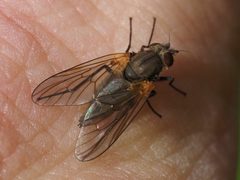
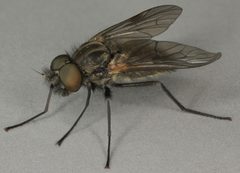
4Symphoromyia is a Holarctic of predatory snipe flies distinguished by unusual among Rhagionidae. range 4.5–9 mm with variable coloration: black, grey, or gold; grey, black, black-and-yellow, or entirely yellow. Some feed on mammal blood, including deer and humans, while others appear predatory. The genus includes five subgenera and multiple fossil species from Eocene Baltic amber.
Pronunciation
How to pronounce Symphoromyia: /sɪmˌfɔːroʊˈmaɪə/
These audio files are automatically generated. While they are not always 100% accurate, they are a good starting point.
Identification
Stout-bodied flies 4.5–9 mm with short scape equal to or longer than (scape at least twice pedicel length in most extant ). black, grey, or gold; variable from grey or black to black with yellow terminal segments or completely yellow. Wings hyaline or lightly infuscate. Distinguished from other Rhagionidae by blood-feeding in females of several species and associated robust mouthpart structure.
Images
Distribution
Holarctic distribution including North America (including Vermont), Europe (West and Central Europe, east to Northwest Russia, Scandinavia: Denmark, Norway, Sweden), and Asia (China). Fossil known from Middle Eocene Baltic amber (~48–37 Ma).
Diet
Blood-feeding () on mammals including deer and humans in some ; predatory likely in others.
Behavior
Females attracted to CO₂-baited traps, indicating CO₂ serves as -seeking cue; trap catches correlate with host attack rates. Males form swarms. Documented attack on deer in Northern California and on humans in Central Italy.
Ecological Role
Blood-feeding function as of mammals; may serve as for microorganisms. Predatory species likely contribute to .
Human Relevance
Biting pest of humans and livestock; some cause painful bites. Documented human-biting records in Italy and elsewhere. Subject to control efforts using CO₂-baited traps.
Sources and further reading
- BugGuide
- Wikipedia
- GBIF taxonomy match
- iNaturalist taxon
- NCBI Taxonomy
- Catalogue of Life
- A new Symphoromyia in the Middle Eocene Baltic amber (Diptera: Rhagionidae)
- Relationship Between Host Attack Rates and Co2-Baited Insect Flight Trap Catches of Certain Symphoromyia Species
- Behavior and reproductive physiology of blood-sucking snipe flies (Diptera: Rhagionidae:Symphoromyia) attacking deer in Northern California
- A REVISION OF THE GENUS SYMPHOROMYIA FRAUENFELD (DIPTERA: RHAGIONIDAE): I. INTRODUCTION. SUBGENERA AND SPECIES-GROUPS. REVIEW OF BIOLOGY
- First report of <em>Symphoromyia immaculata</em> (Diptera: Rhagionidae) from Italy, with the description of its attack and blood-feeding behaviour on human hosts
- First report of phoresy on snipe flies (Diptera: Rhagionidae): the chewing louse Damalinia meyeri (Psocodea: Phthiraptera: Trichodectidae) on Symphoromyia immaculata.