
Nausigaster
Williston, 1884
Species Guides
6- Nausigaster curvinervis
- Nausigaster geminata(Armored Dimpleback)
- Nausigaster punctulata(Spot-winged Dimpleback)
- Nausigaster scutellaris(Plain-winged Dimpleback)
- Nausigaster texana(Silver Dimpleback)
- Nausigaster unimaculata(Single-spotted Dimpleback)
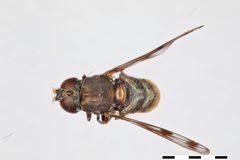
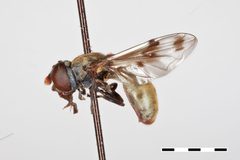
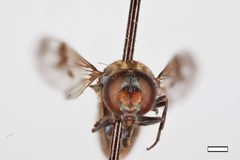
Nausigaster is a of hoverflies (Syrphidae) to the New World, containing approximately 15 described . The genus was established by Williston in 1884. Larvae have been documented developing in decaying cacti and bromeliads, suggesting a specialized association with these plant substrates. records span from Argentina to Mexico, with recent collections extending known distributions in Colombia and Argentina.
Pronunciation
How to pronounce Nausigaster: //naʊ.sɪˈɡæstər//
These audio files are automatically generated. While they are not always 100% accurate, they are a good starting point.
Images
Habitat
Tropical dry forest; Monte and Chaco Phytogeographical Provinces. Larval specifically includes decaying cacti and bromeliads.
Distribution
New World . Documented from Argentina (Mendoza, Jujuy, La Rioja provinces), Brazil, Colombia (Ecoreserva La Tribuna, 481 m elevation), Mexico, Paraguay, and Venezuela.
Host Associations
- cacti - larval development substratedecaying tissues
- bromeliads - larval development substratedecaying tissues
Life Cycle
Larval stage develops in decaying plant material; specific details of other life stages not documented.
More Details
Collection Methods
have been collected using in tropical dry forest settings.
Taxonomic Notes
First record of the from Argentina since 1892; N. meridionalis represents the first Colombian record with precise geographic data.
Sources and further reading
- BugGuide
- Wikipedia
- GBIF taxonomy match
- iNaturalist taxon
- NCBI Taxonomy
- Catalogue of Life
- First records of Nausigaster flukei (Diptera, Syrphidae) from Argentina
- First record of <i>Nausigaster meridionalis</i> Townsend (Diptera: Syrphidae) from Colombia Primer registro de <i>Nausigaster meridionalis</i> Townsend (Diptera: Syrphidae) en Colombia