
Meromacrus acutus
(Fabricius, 1805)
Carolinian elegant
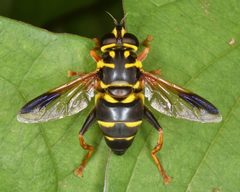
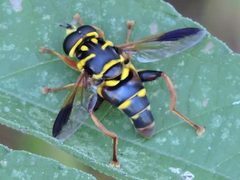
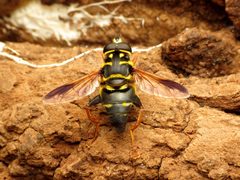
Meromacrus acutus is a large syrphid fly, commonly known as the Carolinian elegant, distributed in the Eastern United States and South America. display striking black and yellow coloration that mimics , a common defensive strategy in hoverflies. The larvae are aquatic filter-feeders of the rat-tailed type, inhabiting rot holes in trees. This uncommon is notable for its size and distinctive wing venation among North American hoverflies.
Pronunciation
How to pronounce Meromacrus acutus: /ˌmɛrəˈmækrəs əˈkjuːtəs/
These audio files are automatically generated. While they are not always 100% accurate, they are a good starting point.
Identification
Distinguished from other Meromacrus and similar large syrphids by combination of: large size (13–18 mm), vivid golden yellow thoracic markings with specific pattern of paired humeral spots and transverse lateral line, closed r2+3 in wing venation, and predominantly black hind contrasting with otherwise light reddish-yellow legs. The -mimicking coloration separates it from non-mimetic hoverflies, but careful examination of thoracic pattern and wing venation required to distinguish from other yellow-and-black syrphids.
Images
Habitat
found around flowers. Larvae inhabit rot holes in trees, where they are aquatic filter-feeders.
Distribution
Eastern United States and South America.
Diet
feed on nectar and pollen from flowers. Larvae are aquatic filter-feeders.
Life Cycle
Larvae are aquatic filter-feeders of the rat-tailed type, found in rot holes of trees.
Behavior
hover near flowers. The exhibits -mimicking coloration, likely serving as defensive mimicry.
Ecological Role
function as when visiting flowers for nectar and pollen. Larvae contribute to nutrient cycling in tree rot holes through filter-feeding activity.
Similar Taxa
- Other Meromacrus speciesShare characteristics including large size and -mimicking coloration; require detailed examination of thoracic pattern and wing venation for separation
- Spilomyia and other large wasp-mimicking syrphidsSimilar black-and-yellow coloration and size; distinguished by specific thoracic marking pattern and wing venation details of M. acutus