
Pachygaster
Meigen, 1803
Species Guides
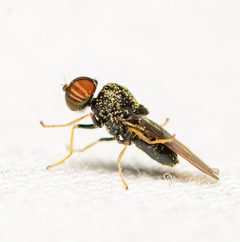
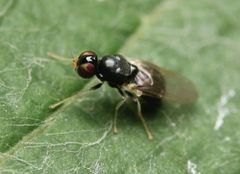
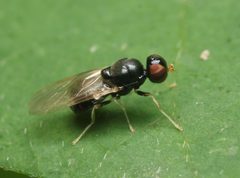
2Pachygaster is a of soldier flies in the Stratiomyidae, Pachygastrinae. The genus is distinguished by specific wing venation and thoracic characteristics, including separate R4 and R5 radial , a scutellum lacking a distinct rim, and non-flattened hairs on the sides of the . Multiple have been described across the genus, with records spanning Europe, Asia, and other regions.
Pronunciation
How to pronounce Pachygaster: //ˌpækɪˈɡæstər//
These audio files are automatically generated. While they are not always 100% accurate, they are a good starting point.
Identification
Distinguished from other Pachygastrinae by three morphological characters: R4 and R5 radial are separate (not or convergent); scutellum lacks a distinct rim; and hairs on the sides of the are not flattened. These traits are diagnostic for the and can be observed in specimens.
Images
Distribution
of Pachygaster have been recorded from Europe, Asia, and other regions based on described species. Specific locality data includes: P. leachii (United Kingdom), P. atra (Europe), P. pulcher (Europe), P. flavipennis (United Kingdom), P. annulipes (India), P. kerteszi (Hungary), P. dorsalis and P. flavimanus (Taiwan), P. characta and P. montana (North America), P. wirthi (North America), P. antiquus (North America), P. maura (Europe), P. piriventris (Slovakia), P. emerita and P. subatra (Israel), and P. hymenaea (Baltic amber).
Similar Taxa
- Other Pachygastrinae generaPachygaster differs in having separate R4 and R5 (versus convergent or in related ), scutellum without rim, and non-flattened mesonotal hairs.
Sources and further reading
- BugGuide
- Wikipedia
- NCBI Taxonomy
- Catalogue of Life
- Herbivorie/omnivorie chez Praephippigera pachygaster Lucas, 1849 (Orthoptera, Tettigoniidae), dans l'est algérien
- Molecular identification, early development and distribution of larval blunthead puffer Sphoeroides pachygaster (Teleostei: Tetraodontidae) off southeastern Brazil
- Spatial and Temporal Distribution of Praephippigera pachygaster Lucas (Orthoptera, Tettigoniidae) in Relation to the Vegetation Structure of an Agrosystem
- Additional record of Sphoeroides pachygaster (Pisces: Tetraodontidae) in the Tyrrhenian Sea and notes on the distribution of the species in the Mediterranean