
Nemopoda nitidula
(Fallén, 1820)
black scavenger fly
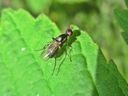
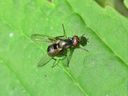
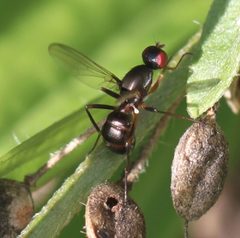
Nemopoda nitidula is a black scavenger fly in the Sepsidae, distributed across Europe and into tropical and temperate regions globally. are primarily black with distinctive red and pale-yellow forelegs; males possess sexually dimorphic forelegs adapted for positioning, mounting, clamping, and copulation. The has been the subject of genomic research, with a high-quality reference assembled from a specimen collected in Wytham Woods, Oxfordshire, UK.
Pronunciation
How to pronounce Nemopoda nitidula: /nɛˈmɒpoʊdə nɪˈtɪdjʊlə/
These audio files are automatically generated. While they are not always 100% accurate, they are a good starting point.
Images
Habitat
Damp and cool locations such as woodlands and areas with vegetation cover.
Distribution
Widespread in Europe with highest records from the United Kingdom and the Netherlands; generally distributed in tropical and temperate climes globally. Country-specific distribution varies based on altitude, humidity, temperature, wind velocity and seasonal variations.
Diet
Animal and decomposing plant and animal remains; can thrive on various substrates derived from decaying faeces, carrion, vegetation and fungi.
Host Associations
- Vickermania spadyakhi - parasitic flagellate of the Trypanosomatidae , found in
Behavior
Males possess sexually dimorphic forelegs useful for successful positioning, mounting, clamping and copulation. Females can dislodge males or halt copulation attempts via vigorous shaking and other strategies.
Ecological Role
Ecologically relevant in microbial and nutrient cycling.
Sources and further reading
- BugGuide
- Wikipedia
- GBIF taxonomy match
- NCBI Taxonomy
- Catalogue of Life
- Meloidae Holdings | Entomology Research Museum
- Nymphula nitidulata Archives - Entomology Today
- The Lepidopteran Life Aquatic
- Bug Eric: Beetles from Bones
- The Changing Distributions of our Grasshoppers, Crickets and Relatives - Buglife Blog - Buglife
- Super Crop Challenge #7 | Beetles In The Bush
- The genome sequence of the black scavenger fly, Nemopoda nitidula (Fallén, 1820).