
Aulacigastridae
Sap Flies
Genus Guides
1is a small of true flies (Diptera) commonly known as sap flies. The family was redefined in 1984 when Stenomicridae was separated from it. Members are found globally across all ecoregions. Both larvae and have specialized feeding habits associated with tree sap and fermenting substances.
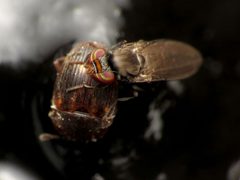
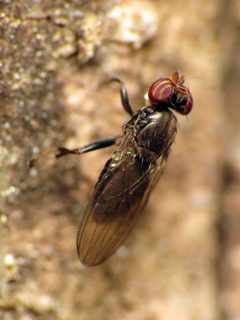
Pronunciation
How to pronounce Aulacigastridae: //ɔːˌlæksɪˈɡæstrɪdiː//
These audio files are automatically generated. While they are not always 100% accurate, they are a good starting point.
Identification
Distinguished from similar small black flies by the unique wing venation: interrupted near the subcosta, basal and discoidal wing , and anal ending before the wing margin. The bristle pattern on the and is also diagnostic, particularly the forward-directed orbital bristle and paired dorsocentral bristles. Previously confused with Stenomicridae, which was separated as a distinct in 1984.
Images
Appearance
Small black flies with rounded . Diagnostic features include: absence of postvertical and ocellar bristles; two orbital bristles on each side of the with the bristle directed forward and toward the line; well-developed vibrissae; two pairs of dorsocentral bristles on the . Wing venation is distinctive: interrupted near the subcosta, which reaches the costa; basal wing and discoidal wing cell ; anal does not reach the wing margin.
Habitat
Associated with deciduous and coniferous forests where tree sap flows occur. Larval is specifically sap runs on living trees. habitat extends to areas with fermenting substances and nectar sources.
Distribution
; recorded from all ecoregions including West Palaearctic (including Russia), Nearctic, Australasian/Oceanian regions, and Japan. Distribution records confirmed from Denmark, Norway, and Sweden.
Diet
Larvae feed on sap from deciduous and coniferous trees, specifically utilizing sap runs, and consume microorganisms within the sap. feed on nectar and other fermenting substances.
Life Cycle
Larval development occurs in sap runs on living trees. Specific details of -laying, , and time are not documented.
Behavior
Larvae are restricted to sap runs where they feed on microorganisms in the sap. are attracted to fermenting substances.
Ecological Role
Larvae contribute to nutrient cycling in tree sap by consuming and processing microorganisms. Their presence in sap runs indicates active microbial in these microhabitats.
Human Relevance
No documented economic importance. Occasionally encountered by entomologists and naturalists in forest . The 's small size and specialized habitat make it unlikely to be noticed by the general public.
Similar Taxa
- StenomicridaeFormerly included within ; separated by Papp in 1984 based on morphological differences. Historical taxonomic confusion may persist in older literature.
More Details
Taxonomic History
The was redefined when Papp moved Stenomicridae to separate family status in 1984. Identification keys for Palaearctic by Duda (1934) and Stackelberg (1988) require revision.
Research Status
The remains poorly studied with limited -level . Nearctic species were revised by Mathis and Freidberg (1994).