
Lucilia eximia
(Wiedemann, 1819)
green bottle fly
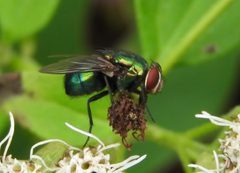
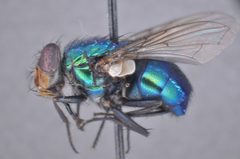
Lucilia eximia is a green bottle fly in the Calliphoridae, distributed throughout the Neotropics from northern Mexico to southern South America. The is a significant forensic indicator used to estimate minimum postmortem intervals, with well-documented intra-puparial development stages and thermal accumulation requirements. Laboratory studies indicate require both sugar and protein sources for optimal longevity, with water deprivation severely reducing survival. The species colonizes animal remains in urban environments exposed to sunlight.
Pronunciation
How to pronounce Lucilia eximia: /lʊˈsɪliə ɛɡˈzɪmiə/
These audio files are automatically generated. While they are not always 100% accurate, they are a good starting point.
Images
Habitat
Urban environments, particularly animal remains exposed to sunlight. Laboratory rearing successful at 25.46±1.21°C, 93.31±2.41% relative humidity, with 12:12 light:dark and vermiculite substrate for .
Distribution
Neotropical region, ranging from northern Mexico to southern South America. Documented in Rica, Colombia (Florencia, Caquetá), and Brazil (widespread across states including AC, AM, AP, BA, CE, DF, ES, GO, MA, MG, MS, MT, PA, PB, PE, PR, RJ, RN, RO, RR, RS, SC, SP, TO). Also present in Galápagos Islands.
Diet
Necrophagous. Larvae feed on animal remains and carcasses. require sugar and protein sources for optimal longevity; protein deprivation reduces survival compared to sugar-only diets.
Life Cycle
Complete with documented intra-puparial development. Pre-pupa stage lasts 80±1.5 hours, involving larval contraction, cephalic retraction into second segment, segment invagination (12th into 11th continuing to 8th into 7th), barrel shape formation, intestine emptying, and 25.53% length reduction. Intra-puparial development totals 302±3.81 hours: larva-pupa (23±1.08 h), cryptocephalic pupa (5±0.53 h), phanerocephalic pupa (92±1.94 h), with transparent (125±2.15 h), yellow eyes (23±0.89 h), pink eyes (14±0.73 h), and red eyes (20±0.60 h). Pharate adult completely formed at 296 hours; adult at 302±3.81 h. Total requires 7,236.50 accumulated degree hours.
Behavior
Post-feeding larvae stop feeding, become pink, leave carcass to find substrate, and remain active for approximately 6 hours before burrowing.
Ecological Role
Forensic for estimating postmortem interval in medicolegal investigations. Contributes to decomposition of animal remains in urban environments. characterized by -dependent and survival parameters predicting one-point equilibrium for immatures.
Human Relevance
Primary forensic importance as a biological indicator for postmortem interval estimation. Used in investigations throughout Central and South America. Laboratory studies on longevity under resource deprivation conditions inform time-since- estimates in enclosed environments.
Sources and further reading
- BugGuide
- Wikipedia
- GBIF taxonomy match
- iNaturalist taxon
- NCBI Taxonomy
- Catalogue of Life
- Bohart Museum Features UC Davis Forensic Entomologist Bob Kimsey | Bug Squad
- Learning About the Importance of Blow Flies Through Maggot Art | Bug Squad
- How Blow Flies Compete (or Not) for Decomposition Duties
- Entomological Medicine: Working to Bring Maggot Therapy Into Wider Use
- Bug Eric: Zebra Jumper
- Bug Eric: What's on Dat Scat?
- Population dynamics ofLucilia eximia(Dipt., Calliphoridae)
- Intra-puparial development of Lucilia eximia (Diptera, Calliphoridae)
- Nutrition and Water Deprivation Negatively Impacts Adult Longevity of Lucilia eximia (Diptera: Calliphoridae)
- Determinación del intervalo post mortem mínimo (IPM) basado en un modelo de acumulación térmica con una cepa de Lucilia eximia (Diptera: Calliphoridae) de Costa Rica Lucilia eximia (Diptera: Calliphoridae) as forensic indicator for the calculation of the post mortem interval in Costa Rica.