
Calliphora livida
Hall, 1948
slow-flying and loud-buzzing blue bottle fly
Calliphora livida is a blow fly in the Calliphoridae, commonly known as blue bottle flies. It is a medium-sized fly with a blue metallic sheen dulled by dense micromentum. The is widespread across North America and is notable for its relatively delayed arrival on carrion compared to other blow flies, typically appearing approximately 24 hours after death. It prefers cooler, shaded environments with temperatures ranging from 4 to 15.6°C. The species holds significant forensic importance for post-mortem interval estimation, particularly during spring and colder months when other blow fly species may be less active.
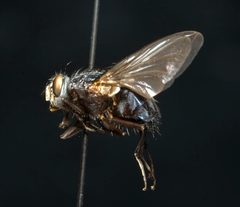
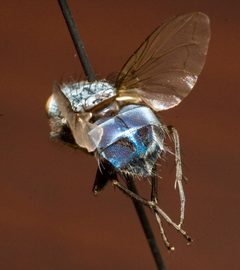
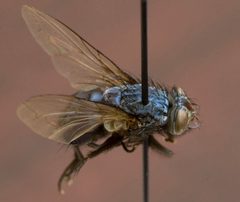
Pronunciation
How to pronounce Calliphora livida: //ˈkælɪˌfɔːrə ˈlɪvɪdə//
These audio files are automatically generated. While they are not always 100% accurate, they are a good starting point.
Identification
Distinguished from the similar Calliphora coloradensis by its black genal dilation (cheek area), whereas C. coloradensis has a red genal dilation. However, this characteristic is reliable only in fully sclerotized specimens; (newly emerged, not fully hardened) specimens of C. coloradensis may show dark genal dilation, causing potential misidentification. Both share three postsutural intra-alar setae. The species is further characterized by its relatively slow and loud buzzing compared to other blow flies.
Images
Habitat
Prefers shady locations and is found at significantly lower temperatures than many other blow fly . Active in temperature ranges of 4 to 15.6°C (39.2 to 60.1°F). Associated with carrion and excrement in both rural and urban environments.
Distribution
Widespread across North America. Distribution records include Vermont and other parts of the United States.
Seasonality
Normally active during springtime, but can also be found during colder months when other blow fly are less active. This extended seasonality contributes to its forensic utility.
Diet
are attracted to carrion and excrement. Larvae feed on decomposing animal tissue.
Life Cycle
Complete with four stages: , larva, pupa, and . Total approximately 15–36 days. Eggs hatch within 24–48 hours. Three larval instars last 4–21 days total. Larvae typically disperse 15–20 feet (4.6–6.1 m) before . Pupation lasts 3–20+ days. Optimal growth temperature ranges from 18–30°C, though adults are active at lower temperatures (4–15.6°C). Minimum developmental temperature for larvae approximately 1°C; 4700 accumulated degree hours required from egg hatch to pupation.
Behavior
Exhibits relatively slow with loud buzzing. Arrives on carrion after a delay of approximately 24 hours compared to other blow fly . prefer shaded, cooler microhabitats. Larvae disperse moderate distances before .
Ecological Role
Decomposer and nutrient recycler through consumption of carrion and excrement. Serves as prey for various . Contributes to decomposition processes, particularly in cooler conditions where other blow fly activity may be reduced.
Human Relevance
Primary forensic importance for post-mortem interval (PMI) estimation in medicocriminal investigations. The ' relatively early appearance on carrion (though delayed ~24 hours compared to some other blow flies) and its activity during cooler months make it valuable for time-of-death estimation. Can act as a for bacterial including poliomyelitis and dysentery. Has been reported to cause myiasis, though this is uncommon. Subject to control efforts; lindane (BHC) and paradichlorobenzene (PDB) crystals have shown effectiveness in controlling breeding.
Similar Taxa
- Calliphora coloradensisVery similar ; distinguished by red genal dilation in sclerotized specimens versus black in C. livida. specimens of C. coloradensis may have dark genal dilation, causing identification challenges. Both share three postsutural intra-alar setae.
- Calliphora viridescensHistorically confused with C. livida; C. livida was originally described as part of C. viridescens by Robineau-Desvoidy in 1830 before being recognized as a separate by Hall in 1948.
More Details
Forensic significance
C. livida is one of approximately 12 common blow fly used for post-mortem interval estimation, alongside Phormia regina, Calliphora vomitoria, Lucilia cuprina, Lucilia sericata, Lucilia illustris, Chrysomya rufifacies, Chrysomya megacephala, Cochliomyia macellaria, Protophormia terraenovae, Calliphora vicina, and Cynomya mortuorum.
Historical taxonomy
First described as a distinct by D.G. Hall in 1948 in one of the first entomology textbooks, correcting the earlier misclassification by Jean-Baptiste Robineau-Desvoidy who had placed it within Calliphora viridescens in 1830.
Sources and further reading
- BugGuide
- Wikipedia
- GBIF taxonomy match
- iNaturalist taxon
- NCBI Taxonomy
- Catalogue of Life
- Bohart Museum of Entomology Open House: Magnificent Maggot Art! | Bug Squad
- Maggot Art at UC Davis Picnic Day: Just Me and My Maggot | Bug Squad
- In the Blink of a Fly: Flies' Upside-Down Landings Inspire Robot Designs
- Advanced Mass Spectrometry Method Could Give Forensic Entomologists Faster Fly IDs
- Bug Eric: What's on Dat Scat?
- Hymenoptera | Blog