
Tanypezidae
Stretched-foot Flies
Genus Guides
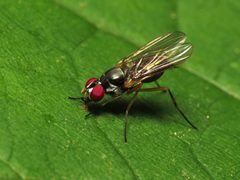
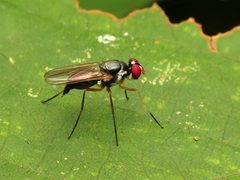
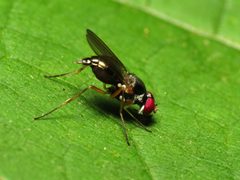
1is a small of acalyptrate Diptera containing 28 in two . The family is primarily New World in distribution, with Tanypeza (2 species) occurring in North America and the Palearctic, and Neotanypeza (26 species) restricted to the Neotropics. Species are characterized by their relatively large size, semispherical , stout bodies, and notably long, thin legs that give the family its . The of most species remains poorly known.
Pronunciation
How to pronounce Tanypezidae: /ˌtænɪˈpɛzɪdiː/
These audio files are automatically generated. While they are not always 100% accurate, they are a good starting point.
Identification
Distinguished from similar Neriidae and Micropezidae by the combination of semispherical , stout body on long thin legs, and specific wing venation features including convergence of R4+5 and M1. The presence of a large, flat ocellar disc and absence of vibrissae and setulae on R1 are additional diagnostic characters. The dark coloration with contrasting silver or golden-haired stripes and spots on the head and is distinctive.
Images
Appearance
Relatively large flies with semispherical and stout bodies perched atop long, thin legs. The head and are often very dark with contrasting silver or sometimes golden-haired stripes and spots. Wing venation shows convergence of R4+5 and M1. No vibrissae are present. The upper surface of vein R1 lacks setulae. A large, flat ocellar disc is present behind the ocelli.
Habitat
Tanypeza longimana has been observed in low vegetation in humid deciduous woodlands, often in association with running water. General preferences for other are not well documented.
Distribution
Primarily New World distribution. Tanypeza (2 ): North America, with T. longimana extending into the Palearctic (including Czech Republic, Slovakia, Denmark, Norway, Sweden). Neotanypeza (26 species): Neotropical, including one extinct species known only from Dominican amber (17–20 million years ago).
Similar Taxa
- NeriidaeLong-legged flies with superficially similar body plan, but distinguished by different shape, wing venation, and absence of the large flat ocellar disc characteristic of
- MicropezidaeStilt-legged flies with elongated legs, but differ in body proportions, shape, and wing venation details including the convergence of R4+5 and M1 found in
- StrongylophthalmyiidaeSister with contrasting distribution (mostly East Asian), differing in morphological details and biogeographic pattern
More Details
Taxonomic history
The was redefined by Lonsdale (2013), who synonymized all neotropical tanypezid into Neotanypeza. A complete catalogue was provided by Lonsdale (2014).
Fossil record
Neotanypeza dominicana is known only from Dominican amber dated to 17–20 million years ago, representing the only described fossil in the .