
Strongylophthalmyia
Heller, 1902
Species Guides
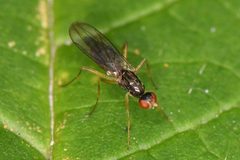
1Strongylophthalmyia is a of slender, long-legged flies in the Strongylophthalmyiidae. Most occur in the Oriental and Australasian regions, with some extending into the Palearctic. Males exhibit highly modified antennal structures with variable processes on the first flagellomere. The genus contains approximately 40 described species, including several named in honor of public figures.
Pronunciation
How to pronounce Strongylophthalmyia: /strɒnˌɡɪlɒfˈθælmɪə/
These audio files are automatically generated. While they are not always 100% accurate, they are a good starting point.
Identification
Distinguished from other dipteran by combination of: slender body with long legs; male first flagellomere with variable process(es); bare ; simple fore without thorn-like spicules. The S. coarctata subgroup specifically characterized by these antennal modifications. -level identification requires examination of male genitalia and antennal process .
Images
Appearance
Slender-bodied flies with notably long legs. Males possess highly modified first flagellomere of the bearing variable processes: bifid with and projections, or single process below insertion. These antennal processes vary in length and shape, ranging from short and stout to extremely long, thin, whip-like, sword-like, or conical. Some bear dense setulae on antennal processes, colored black or whitish. Arista is bare. Fore simple, lacking thorn-like spicules.
Distribution
Predominantly Oriental and Australasian regions. recorded from Thailand, Borneo, Philippines, Sumatra, Malay Peninsula, Laos, Cambodia, Vietnam, China (Yunnan, Sichuan, Taiwan), Indonesia, Malaysia, northern Burma. Palearctic extensions include Russia, Europe (S. ustulata), and North America (S. pengellyi in Canada and United States).
Behavior
Males use modified antennal structures in recognition, though specific function not experimentally confirmed. Specimens have been collected using .
Human Relevance
S. federeri named after tennis champion Roger Federer due to male palpus resembling a racquet. S. phillindablank named with compound epithet. Taxonomic interest in antennal provides model for studying and diversification.
Similar Taxa
- Other Strongylophthalmyiidae generaStrongylophthalmyia distinguished within by specific antennal modifications and simple fore ; other lack the characteristic male first flagellomere processes.
- Micropezidae (stilt-legged flies)Both have long legs and slender bodies, but Micropezidae lack the modified male antennal structures and have different wing venation.
More Details
Taxonomic history
established by Heller in 1902. Strongylophthalmyiidae historically placed in various superfamilies; current classification in Ephydroidea or as distinct lineage. Significant revision by Evenhuis (2016) described numerous new from Southeast Asia.
Collection methods
Specimens collected using and other passive sampling methods in forested ; specific microhabitat associations poorly documented.
Sources and further reading
- BugGuide
- Wikipedia
- GBIF taxonomy match
- iNaturalist taxon
- NCBI Taxonomy
- Catalogue of Life
- Seven new species of Strongylophthalmyia Heller, 1902 (Diptera: Strongylophthalmyiidae) from the Eastern Palaearctic and Oriental Regions with notes on peculiar rare species
- A review of the Strongylophthalmyiacoarctata subgroup (Diptera, Brachycera, Strongylophthalmyiidae) from China, with the descriptions of three new species.