
Rainieria antennaepes
(Say, 1823)
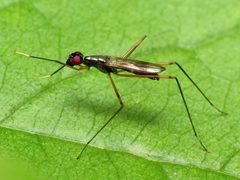
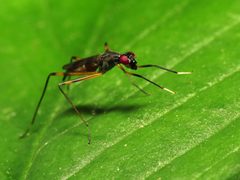
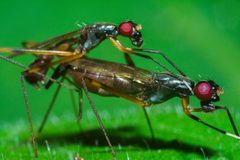
Rainieria antennaepes is a stilt-legged fly ( Micropezidae) native to eastern North America. The is notable for its distinctive of holding its white-tipped front legs aloft and waving them to mimic the of ichneumonid wasps—a form of protective mimicry. It is the only member of its occurring in North America, making identification straightforward within its range. The specific epithet "antennaepes" translates to "antenna foot," directly referencing this remarkable leg display.
Pronunciation
How to pronounce Rainieria antennaepes: //reɪˈnɪəriə ænˌtɛn.iəˈpiːz//
These audio files are automatically generated. While they are not always 100% accurate, they are a good starting point.
Identification
The combination of geographic location (eastern North America), white-tipped front legs held in an elevated, waving posture, and overall stilt-legged distinguishes this . No other Rainieria species occurs in North America, eliminating confusion with . The leg-waving mimicry of ichneumonid is diagnostic when observed.
Images
Appearance
Slender-bodied fly with exceptionally long, thin legs characteristic of the Micropezidae . The front legs have white tips, which are prominently displayed during the ' characteristic leg-waving . Body proportions and leg length give a -like overall silhouette.
Habitat
Specific associations are not well documented in available sources.
Distribution
Eastern North America, occurring in regions east of the Rocky Mountains. Distribution records include Vermont and other eastern United States localities.
Diet
Feeds on detritus, bird droppings, and similar organic waste materials.
Behavior
Frequently holds white-tipped front legs elevated and waves them in a manner that mimics the of ichneumonid wasps. This represents protective mimicry, potentially deterring by resembling unpalatable or dangerous .
Ecological Role
Contributes to decomposition and nutrient cycling through consumption of detritus and organic waste.
Human Relevance
No direct economic or medical significance documented. The ' mimicry makes it a subject of interest for studies of protective mimicry in insects.
Similar Taxa
- Other MicropezidaeShare long-legged but lack the specific white-tipped front legs and - mimicry ; other Rainieria do not occur in North America
- Ichneumonid waspsResembled through leg-waving mimicry, but distinguished by having six legs (flies) versus eight legs plus distinct (), and by
More Details
Etymology
The specific epithet "antennaepes" is derived from Latin, meaning " foot," directly describing the ' remarkable leg and .
Taxonomic uniqueness
This is the sole representative of the Rainieria in North America, making it geographically isolated from its .