
Limnophora
Robineau-Desvoidy, 1830
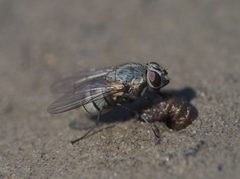
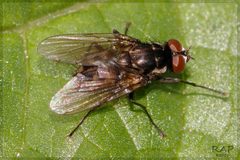
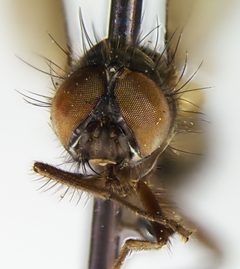
Limnophora is a of muscid flies established by Robineau-Desvoidy in 1830, comprising approximately 230 distributed worldwide. The genus is characterized by distinctive silver bands across the and serves as the namesake for the tribe Limnophorini. Species occur in diverse including riverine environments, karst formations such as tufa barriers, and high montane forests. The genus includes notable species such as Limnophora riparia, a documented of larval black flies, and L. marginata, which has been studied for genetic and morphometric variation across altitudinal gradients.
Pronunciation
How to pronounce Limnophora: //lɪmˈnɒfɔːrə//
These audio files are automatically generated. While they are not always 100% accurate, they are a good starting point.
Identification
Distinguished from other Muscidae by the presence of silver bands across the . Similar with mesonotal patterns (such as Anthomyia) can be separated by specific band arrangement and wing venation details. Identification to level requires examination of male terminalia and ovipositor ; keys exist for Chinese species (49 species) and Macaronesian fauna. L. obsignatula of the western Canary Islands replaces the widespread continental L. obsignata and requires careful separation based on subtle morphological differences.
Images
Habitat
Riverine and riparian ; tufa barriers and karst formations; evergreen high montane forest at 3400 m elevation; dry forest at 2500 m elevation. Specific microhabitat preferences vary by , with some showing strong association with running water environments.
Distribution
Worldwide distribution with records from: Europe (including Scandinavia, Greenland), Macaronesia (Canary Islands: 10 ; Cape Verde Islands: 4 species; Madeira: 3 species), China (49 species documented), Ecuador (11 species, with L. marginata most abundant), Iraq (L. obsignata recorded from Kerbala governorate), and Colombia (Cundinamarca).
Seasonality
activity observed in spring and autumn in temperate regions, associated with moderate temperatures and humidity. Year-round presence possible in tropical high-elevation ; patterns studied over long time periods in karst environments.
Diet
L. riparia is a documented of larval black flies (Simuliidae). General feeding habits for most not documented in available sources.
Life Cycle
Complete with , larval, pupal, and stages. Specific developmental details not documented for most ; L. riparia includes predatory larval stage.
Behavior
exhibit -specific patterns studied over extended periods in tufa barrier environments. L. marginata shows morphometric plasticity in wing shape associated with habitat differences between evergreen high montane forest and dry forest .
Ecological Role
L. riparia functions as a of larval black flies in aquatic and semi-aquatic . Potential role in of simuliid black flies; broader ecosystem functions for not documented.
Human Relevance
L. riparia may provide services against black fly . Several acutely threatened due to disturbance, particularly in insular such as the Canary Islands. Subject of population genetic and morphometric research using mitochondrial markers.
Similar Taxa
- AnthomyiaShares mesonotal patterning but differs in specific silver band arrangement on ; L. obsignata and L. tigrina previously misidentified as Anthomyia due to superficial pattern similarity.
- Other CoenosiinaeLimnophorini tribe members share affiliation but Limnophora is distinguished by the silver thoracic bands that give the tribe its name.
Misconceptions
L. obsignata and L. tigrina were erroneously listed as present in the Canary Islands based on misidentifications; these continental are replaced by L. obsignatula and other forms in Macaronesia.
More Details
Taxonomic history
The tribe Limnophorini is named from this . Recent revisions have clarified boundaries in Macaronesia and China, with two new Chinese species described (L. biprominens, L. latifrons) and taxonomic revisions (L. guizhouensis synonymized with L. pubiseta). L. beckeri represents a new country record for China.
Population genetics
L. marginata in Ecuador show high intra-population genetic variability (94%) versus low inter-population differentiation (6%), suggesting maintains connectivity across altitudinal gradients despite differences between 2500 m and 3400 m elevations.
Conservation status
Multiple Macaronesian identified as acutely threatened due to disturbance in island .
Sources and further reading
- BugGuide
- Wikipedia
- GBIF taxonomy match
- iNaturalist taxon
- NCBI Taxonomy
- Catalogue of Life
- Descriptive study of the species Limnophora Robineau-Desvoidy 1830 (Diptera:Muscidae) in Iraq – Kerbala
- FAUNISTICAL STUDIES ON THE GENUS LIMNOPHORA IN CHINA (DIPTERA: MUSCIDAE)
- Long-time emergence patterns of Limnophora species (Diptera, Muscidae) in specific karst habitats: tufa barriers
- To the biology of muscid flies of the genus Limnophora Robineau-Desvoidy, 1830 (Diptera: Muscidae)
- The Life History and Behavior of Limnophora riparia (Diptera:Muscidae), a Predator of Larval Black Flies
- Macaronesian Muscidae (Diptera). II. The genus Limnophora Robineau-Desvoidy with description of a new Canarian endemic species
- Short Communication: Morphometric variations in two populations of Limnophora marginata Stein, 1904 (Diptera, Muscidae) in Ecuador
- Genetic variation of Limnophora marginata Stein, 1904 (Diptera: Muscidae), associated with an altitudinal gradient in Pedro Moncayo Canton, Pichincha, Ecuador