
Botanophila
Lioy, 1864
Species Guides
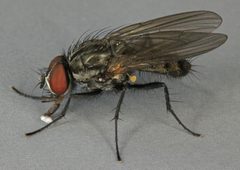
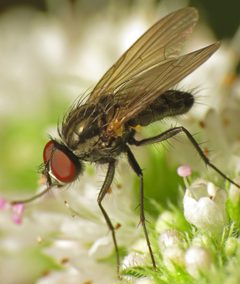
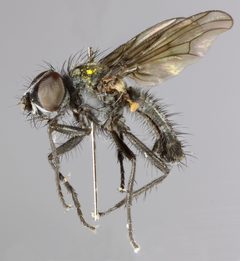
1Botanophila is a of over 200 of anthomyiid flies, predominantly phytophagous, with diverse ecological specializations. A distinctive species group maintains an obligate mutualism with Epichloë fungi, acting as for fungal spermatia transfer required for . Other species are associated with plants, including thistle-feeding species with potential for . One species, B. fonsecai, is to a 6 km stretch of Scottish coastline and is globally endangered.
Pronunciation
How to pronounce Botanophila: //ˌboʊ.təˈnɒ.fɪl.ə//
These audio files are automatically generated. While they are not always 100% accurate, they are a good starting point.
Identification
Epichloë-associated Botanophila form a distinct monophyletic clade, distinguishable from other Botanophila by their specialized association with fungal stromata. Within this clade, European and North American can be differentiated by mitochondrial COII sequences; at least six distinct taxa have been identified across both continents. Thistle-feeding species such as B. turcica and B. spinosa attack rosette meristems prior to flowering and can be distinguished by their associations and activity periods—B. turcica is active for 6 months from late autumn, while B. spinosa is active for 2–3 months in spring.
Images
Habitat
vary by group. Epichloë-associated species occur in grasslands and meadows where grasses infected by Epichloë fungi are present. Thistle-feeding species inhabit areas with their host thistles, including Carthamus lanatus and Onopordum acanthium. Botanophila fonsecai is restricted to dynamic coastal sand dune systems with dune vegetation, specifically along the Sutherland coast of Scotland.
Distribution
The has been recorded from Denmark, Norway, and Sweden. Epichloë-associated occur in Europe and North America. Botanophila fonsecai is to approximately 6 km of coastline between Dornoch and Loch Fleet in East Sutherland, Scotland, and has not been found elsewhere.
Seasonality
activity periods vary among . Botanophila turcica exhibits adult activity from late autumn through spring, lasting approximately 6 months. Botanophila spinosa is active for 2–3 months in spring. Seasonal timing of Botanophila fonsecai activity is not documented.
Diet
Larvae of Epichloë-associated feed on fungal stromata and surrounding plant tissue; feed on fungal spermatia. Thistle-feeding species such as B. turcica and B. spinosa feed on rosette meristem tissue of their thistles. The diet of B. fonsecai is not documented.
Host Associations
- Epichloë fungi - mutualistFlies act as obligate for spermatia transfer; larvae develop within fungal stromata
- Carthamus lanatus - herbivore of B. turcica; larvae feed on rosette meristems
- Onopordum acanthium - herbivore of B. spinosa; larvae feed on rosette meristems
- Holcus lanatus - indirectGrass of Epichloë fungi associated with Botanophila flies
Life Cycle
Epichloë-associated : deposited on fungal stromata; larvae develop within stromata, consuming fungal tissue; emerge to visit stromata for feeding and oviposition. Thistle-feeding species: eggs laid on rosette meristems; larvae feed internally on meristem tissue; occurs in soil. Development of B. fonsecai is not documented.
Behavior
Epichloë-associated Botanophila flies exhibit a pollination-like , transferring viable spermatia between fungal stromata of opposite mating types during defecation after feeding and oviposition. Female flies show oviposition preference for larger stromata in some associations, though this preference varies over time and is not consistent across all -fungus systems. Thistle-feeding attack rosette meristems prior to flowering, with natural attack rates of 21–33% of field plants.
Ecological Role
Epichloë-associated serve as obligate mutualists and for of Epichloë fungi, influencing fungal genetics and the dynamics of grass-endophyte . Thistle-feeding species act as herbivores that can significantly impact plant growth, allocation, and . Botanophila fonsecai represents a unique component of coastal dune biodiversity as a narrow .
Human Relevance
Several have been investigated for of thistles, particularly B. turcica for Carthamus lanatus and B. spinosa for Onopordum acanthium in Australia. However, -specificity testing revealed that B. turcica has a wider host range than initially reported, including potential to develop on safflower (Carthamus tinctorius), creating risk for agricultural crops. Botanophila fonsecai has become a flagship species for conservation, with its restricted range making it a focus of efforts to protect Coul Links, Scotland from development.
Similar Taxa
- ChiastochetaChiastocheta are also anthomyiid flies with obligate mutualistic associations—specifically with globeflowers (Trollius). Phylogenetic analyses indicate Chiastocheta is nested within Botanophila, rendering Botanophila as currently circumscribed.
Misconceptions
The interaction between Epichloë fungi and Botanophila flies was initially described as an obligatory mutualism analogous to pollination, with flies necessary for fungal cross-. Subsequent research demonstrated that fertilization can occur without fly visitation in some , and that the interaction may represent simple foraging by larvae in certain contexts, particularly in recently introduced or fungus- associations.
More Details
Conservation status of B. fonsecai
Botanophila fonsecai is classified as globally endangered and is one of the UK's rarest . First discovered in 1971 and described in 1989, it is known from only 8.1 km of coastline. Surveys in 2010 indicated potential decline at its type locality.
Parasitoid pressure
Thistle-feeding Botanophila are attacked by an endoparasitic eucoilid, Trybliographa sp., which causes 18–23% mortality in both B. turcica and B. spinosa.
Phylogenetic relationships
Molecular phylogenetic studies indicate that Epichloë-associated Botanophila form a distinct clade, suggesting a single ancestral expansion to fungal followed by radiation. European and North American Epichloë-associated do not appear to have separate origins.
Sources and further reading
- BugGuide
- Wikipedia
- GBIF taxonomy match
- iNaturalist taxon
- NCBI Taxonomy
- Catalogue of Life
- Flies not fairways - Buglife Blog - Buglife
- Cuteism - Buglife Blog - Buglife
- So, just what is it that makes Coul Links so special? - Buglife Blog - Buglife
- Biology of the Epichloë–Botanophila interaction: An intriguing association between fungi and insects
- Three-way interaction: severity of tufted grass fungal infection affects Botanophila fly reproduction
- Biology and evolution of the Epichloë-associated Botanophila species found in Europe (Diptera: Anthomyiidae)
- Botanophila flies on Epichloë host species in Europe and North America: no evidence for co‐evolution
- The effect of a rosette-crown fly, Botanophila turcica, on growth,biomass allocation and reproduction of the thistle Carthamus lanatus
- Prevalence and impact of the crown fly, Botanophila spinosa, on its host thistle, Onopordum acanthium, in southern France
- Oviposition Preference ofBotanophilaFlies (Diptera: Anthomyiidae) Towards Stroma Size ofEpichloë(Hypocreales: Clavicipitaceae) Hosts
- The interaction of a Botanophila fly species with an exotic Epichloë fungus in a cultivated grass: fungivore or mutualist?
- Does the Degree of Mutualism between Epichloë Fungi and Botanophila Flies Depend upon the Reproductive Mode of the Fungi?
- Fly in the Ointment: Host-Specificity Challenges for Botanophila turcica, a Candidate Agent for the Biological Control of Saffron Thistle in Australia
- Comparative biology of two rosette crown-feeding flies of the genus Botanophila (Dipt., Anthomyiidae) with potential for biological control of their thistle hosts
- Comparative biology of two rosette crown‐feeding flies of the genus Botanophila (Dipt., Anthomyiidae) with potential for biological control of their thistle hosts