
Anthomyia procellaris
Rondani, 1866
Anthomyia procellaris is a small (5–7 mm) distributed across Europe, the East Palearctic (China, Japan), the Near East, and eastern North America. It is a member of the taxonomically challenging Anthomyia pluvialis . The is closely associated with bird nests, where larvae develop as saprophages on nest materials and droppings. frequent wooded and hedgerows, flying from spring through autumn.
Pronunciation
How to pronounce Anthomyia procellaris: /ˌænθəˈmaɪə proʊˈsɛlərɪs/
These audio files are automatically generated. While they are not always 100% accurate, they are a good starting point.
Identification
Difficult to distinguish from Anthomyia imbrida and Anthomyia pluvialis. Key diagnostic features: (1) the black marking at the wing base is undivided with a straight rear margin (versus divided or differently shaped in relatives); (2) in males, the anterodorsal hairs on the hind tibia number fewer than 9. Examination of male genitalia may be required for definitive identification.
Images
Appearance
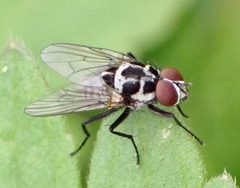
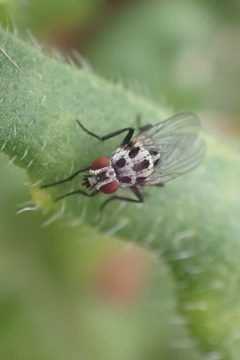
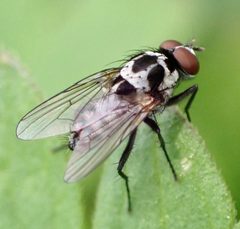
Small fly reaching 5–7 mm in length. Body shows velvety black markings on a greyish ground color. bears three distinct black spots centrally. are bare (without hairs). is robust. is predominantly greyish.
Habitat
Wooded and hedgerows. are frequently observed sun-basking on vegetation.
Distribution
Europe (including Belgium, Denmark, Norway, Sweden), East (China, Japan), Near East, and (Michigan south to North Carolina, USA).
Seasonality
active from spring through autumn.
Diet
feed on nectar, pollen, and excrement. Larvae are saprophagous, feeding on bird droppings and organic matter in bird nests.
Host Associations
- birds - nest inhabitantLarvae develop in bird nests
- Nothris verbascella - associatedDocumented co-occurrence in Cantabria, Spain; ecological relationship unclear
Life Cycle
Larvae develop within bird nests, feeding on nest materials and droppings. occurs in the nest environment. emerge from nests. Specific developmental timing and stage not documented.
Behavior
exhibit sun-basking on vegetation. Strongly associated with bird nest throughout .
Ecological Role
Saprophage in bird nest ; contributes to decomposition of organic matter in avian nesting environments.
Similar Taxa
- Anthomyia imbridaVery similar appearance; distinguished by wing base marking shape and male hind tibia hair count
- Anthomyia pluvialisMember of same ; requires examination of wing base pattern and male genitalia for separation
Sources and further reading
- BugGuide
- Wikipedia
- GBIF taxonomy match
- iNaturalist taxon
- NCBI Taxonomy
- Catalogue of Life
- On the Life History of Anthomyia procellaris Rond. and A. pluvialis L. inhabiting the Nests of Birds
- Nothris verbascella ([Denis & Schiffermüller], 1775) (Lepidoptera, Gelechiidae) y su asociación con el parasitoide Orgilus sp. (Hymenoptera, Braconidae) y el saprófago Anthomyia procellaris Rondani, 1866 (Diptera, Anthomyiidae) en Cantabria (España)
- The Anthomyia pluvialis complex in Europe (Diptera, Anthomyiidae)